
Dichotomous keys and environmental DNASpec A3.1.14, A3.1.15
In short
A dichotomous key identifies organisms through a series of paired choices between observable features, each leading to another pair or a name. Environmental DNA is DNA that organisms shed into soil or water. Sequencing short barcode regions in a sample and matching them to a reference database identifies the species present, so habitat biodiversity can be investigated rapidly.
Dichotomous keys
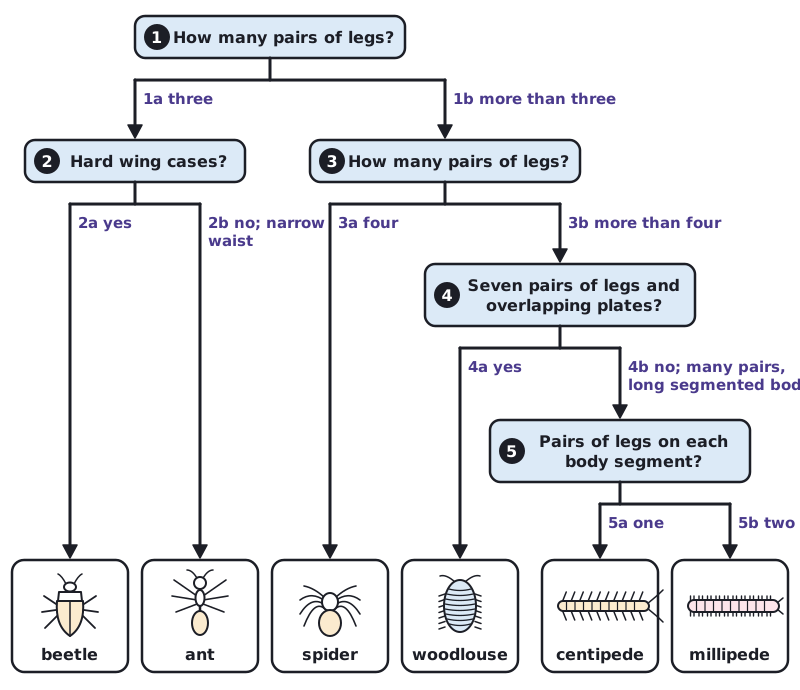
A dichotomous key is a series of numbered steps, each with two contrasting descriptions. Choosing the description that fits leads either to another step or to the name of the organism.
| Step | Description | Go to |
|---|---|---|
| 1a | Three pairs of legs | 2 |
| 1b | More than three pairs of legs | 3 |
| 2a | Hard wing cases covering the abdomen | beetle |
| 2b | No wing cases; narrow waist between thorax and abdomen | ant |
| 3a | Four pairs of legs | spider |
| 3b | More than four pairs of legs | 4 |
| 4a | Seven pairs of legs; body covered by overlapping plates | woodlouse |
| 4b | Many pairs of legs; long, segmented body | 5 |
| 5a | One pair of legs on each body segment | centipede |
| 5b | Two pairs of legs on each body segment | millipede |
Build your key from local species you can observe. Use features that are easy to see and do not vary within a species, such as leg number or leaf arrangement, not size or colour. Test the key on specimens and revise any step that gives the wrong name.
 (opens full size in a new tab)
Environmental DNA and barcodes
Organisms constantly shed cells, mucus, faeces and gametes, so soil and water contain their DNA. This is environmental DNA (eDNA). A DNA barcode is a short, standard section of the genome that differs between species, for example part of a mitochondrial gene in animals or a chloroplast gene in plants.
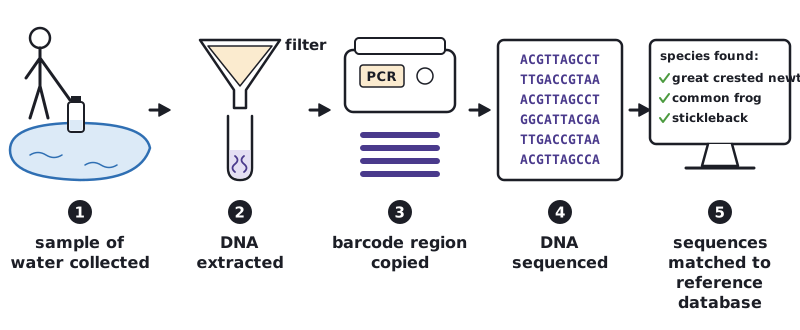
- Collect a sample of water, soil or sediment from the habitat.
- Extract the DNA from the sample.
- Copy the barcode region by PCR, using primers that bind to sequences shared by a whole group of organisms.
- Sequence the copied DNA.
- Compare each sequence with a reference database of barcodes from identified species to find which species are present.
Using barcodes and eDNA allows the biodiversity of habitats to be investigated rapidly. It can detect rare, hidden or microscopic species without catching or even seeing them, for example great crested newts in a pond from a water sample. Limits: a species can only be named if its barcode is in the database, and DNA can drift in from elsewhere or persist after the organism has gone.
 (opens full size in a new tab)
Quick check
In a binomial, which part has a capital letter?
Show answer
The genus name (first part). The species name is all lowercase.
State the biological species concept.
Show answer
A species is a group of organisms that can breed and produce fertile offspring.
How many chromosomes do humans and chimpanzees have?
Show answer
Humans 46, chimpanzees 48.
What is a genome?
Show answer
All the genetic information of an organism.
HL only Why is a mule infertile?
Show answer
Its parents have different chromosome numbers, so its chromosomes cannot all pair in meiosis and viable gametes are not produced.
Written and checked against the IB Biology HL specification · Updated October 2026