
Active sites, induced fit, collisions and denaturationSpec C1.1.4, C1.1.5, C1.1.6, C1.1.7
In short
Enzymes are globular proteins with an active site, a small region of a few amino acids where the substrate binds and catalysis happens. Binding is by induced fit: the substrate and the enzyme both change shape. Substrate and active site must collide, so molecular motion matters. Specificity depends on active site shape and chemistry, and denaturation destroys both.
Enzymes are globular proteins. The polypeptide is folded into a compact, roughly spherical shape that is usually soluble in water. Part of the surface forms the active site, the region where the substrate binds and the reaction is catalysed.
The active site is made of only a few amino acids. Their R groups give it a particular shape and chemical properties (charge, polarity, hydrophobic areas). But these few amino acids are held in exactly the right positions by interactions between amino acids throughout the rest of the protein (hydrogen bonds, ionic bonds, disulfide bonds and hydrophobic interactions). The whole three-dimensional structure is needed for the active site to work.
Induced-fit binding
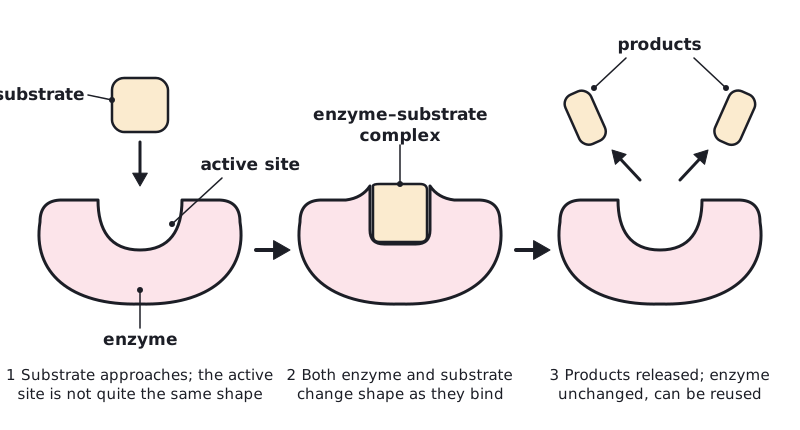
The substrate binds to the active site by chemical attraction between them. In the induced-fit model, both the substrate and the enzyme change shape when binding occurs. The active site moulds more tightly around the substrate, which stresses bonds in the substrate and makes them easier to break or form. The products are then released and the active site returns to its original shape.
 (opens full size in a new tab)
Molecular motion and collisions
For a reaction to be catalysed, a substrate molecule and an active site must collide, in a suitable orientation. Enzymes and substrates dissolved in water move randomly, and these collisions happen by chance. Sometimes only one of them moves: large substrate molecules (such as starch in a starch grain or cellulose in a cell wall) may be immobilised while enzymes move to them, and some enzymes are immobilised by being embedded in membranes while their substrates move to them.
Specificity and denaturation
Enzyme–substrate specificity exists because only a substrate with a shape and chemical properties that match the active site can bind to it. Change the structure of the active site and binding fails.
Denaturation is a change to the three-dimensional structure of the protein, caused by high temperature or extreme pH. Bonds holding the tertiary structure break, so the active site changes shape and its chemical properties change. The substrate can no longer bind, so the enzyme cannot catalyse the reaction. Denaturation is usually permanent.
When explaining denaturation, link the chain: bonds in the tertiary structure break, the active site changes shape, the substrate no longer fits or binds, so no enzyme–substrate complexes form.
Written and checked against the IB Biology HL specification · Updated October 2026