
Cell proliferation and the cell cycleSpec D2.1.12, D2.1.13, D2.1.14, D2.1.15
In short
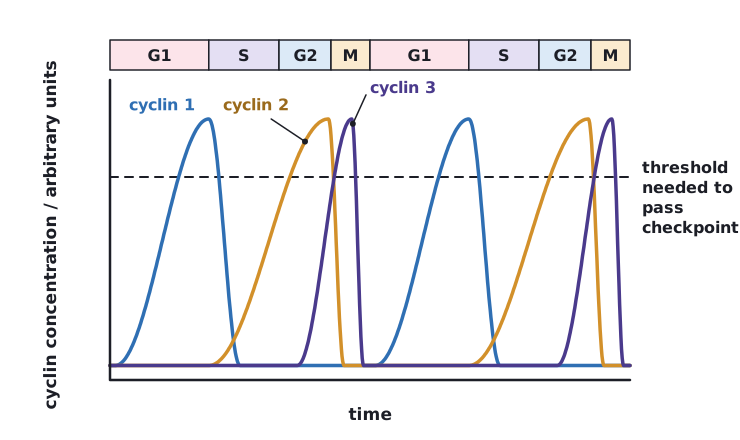
Cell proliferation is the repeated division of cells for growth, cell replacement and tissue repair, and it is achieved using the cell cycle. Interphase (G1, S and G2) is a metabolically active growth period, followed by mitosis and cytokinesis. Rising and falling cyclin concentrations control the cycle: a threshold level of a specific cyclin is needed to pass each checkpoint.
Cell proliferation is a rapid increase in cell number by repeated cell division. It is used for three purposes.
- Growth: in plant meristems (at root and shoot tips) cells divide again and again to add new cells. In early-stage animal embryos the zygote divides repeatedly to form a ball of many cells.
- Cell replacement: in skin, cells in the deepest layer divide continually to replace cells that are lost from the surface.
- Tissue repair: when skin is wounded, cell division increases so that new cells fill and cover the wound.
Phases of the cell cycle
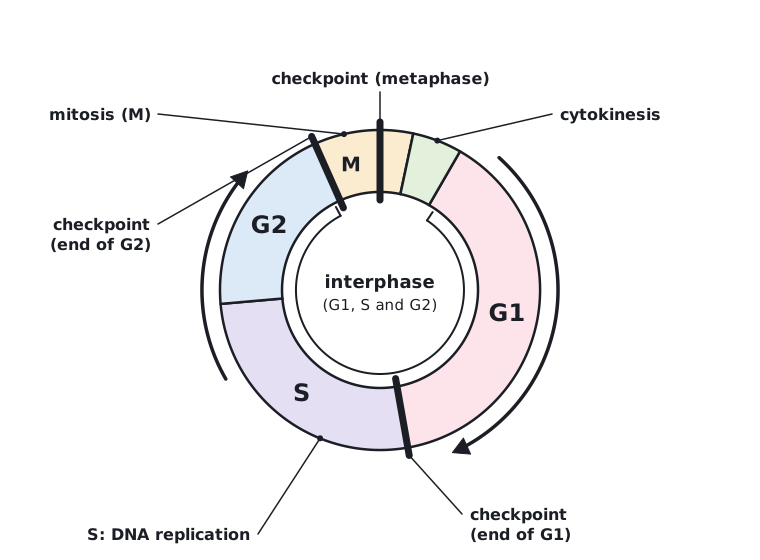
Cell proliferation is achieved using the cell cycle: the sequence of events between one cell division and the next.
| Phase | What happens |
|---|---|
| G1 (interphase) | The cell grows: proteins are made and organelles increase in number |
| S (interphase) | DNA replication: every chromosome is copied, giving two sister chromatids |
| G2 (interphase) | Further growth and preparation for division, for example making the proteins of the spindle |
| Mitosis | The nucleus divides: prophase, metaphase, anaphase, telophase |
| Cytokinesis | The cytoplasm divides, giving two daughter cells |
 (opens full size in a new tab)
 (opens full size in a new tab)
Cell growth during interphase
Interphase is not a resting phase. It is a metabolically active period: the cell carries out respiration, protein synthesis and many other reactions. Growth involves biosynthesis of cell components, including proteins and DNA. The numbers of mitochondria and chloroplasts increase as these organelles grow and divide, so that each daughter cell will receive some.
Control of the cell cycle using cyclins
Cyclins are proteins that control progression through the cell cycle. The concentrations of different cyclins increase and decrease at different points in the cycle. To pass each checkpoint, a threshold level of a specific cyclin is needed. When its concentration is above the threshold, the cell moves into the next phase; the cyclin is then broken down and its concentration falls again.
You do not need the names or roles of specific cyclins. Describe the pattern: concentrations rise and fall, and a threshold of a specific cyclin must be reached to pass each checkpoint.
Written and checked against the IB Biology HL specification · Updated October 2026