
Exact copies by semi-conservative replicationSpec D1.1.1, D1.1.2
In short
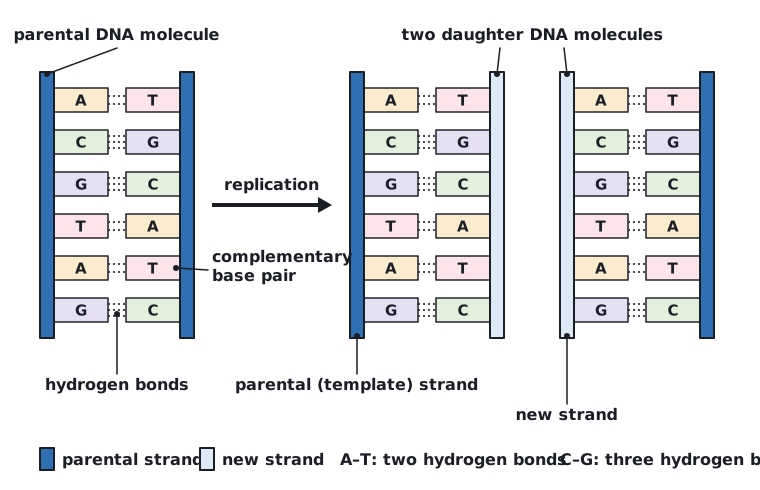
DNA replication is the production of exact copies of DNA with identical base sequences. It is semi-conservative: each new double helix contains one original strand and one new strand. Complementary base pairing (A with T, C with G) means each old strand acts as a template, so the base sequence is copied with a high degree of accuracy.
DNA replication is the production of exact copies of DNA with identical base sequences. It happens before a cell divides, so that each daughter cell receives a full copy of the genome.
- Reproduction: DNA must be copied so that it can be passed to offspring, in asexual reproduction and in the production of gametes.
- Growth: a multicellular organism grows by mitosis, and every new cell needs a complete copy of the DNA.
- Tissue replacement: cells lost through damage or wear (for example skin cells or red blood cell precursors) are replaced by dividing cells, which again need copied DNA.
Semi-conservative replication
The two strands of the double helix separate and each one is used as a template for a new strand. Each of the two DNA molecules produced therefore has one strand from the original molecule (conserved) and one new strand. This is called semi-conservative replication.
Complementary base pairing and accuracy
Free DNA nucleotides are added to the new strand according to complementary base pairing: adenine pairs only with thymine (two hydrogen bonds) and cytosine pairs only with guanine (three hydrogen bonds). Because the base on the template strand decides which base is added, the new strand has exactly the sequence complementary to the template, and the new double helix is identical to the original.
A base that does not pair correctly does not fit or form the right hydrogen bonds, so mismatches are rare. This is why replication copies base sequences with a very high degree of accuracy.
 (opens full size in a new tab)
Semi-conservative does not mean half of each strand is new. Each daughter molecule has one complete old strand and one complete new strand.
Written and checked against the IB Biology HL specification · Updated October 2026