
Lipid bilayers, barriers and simple diffusionSpec B2.1.1–B2.1.3
In short
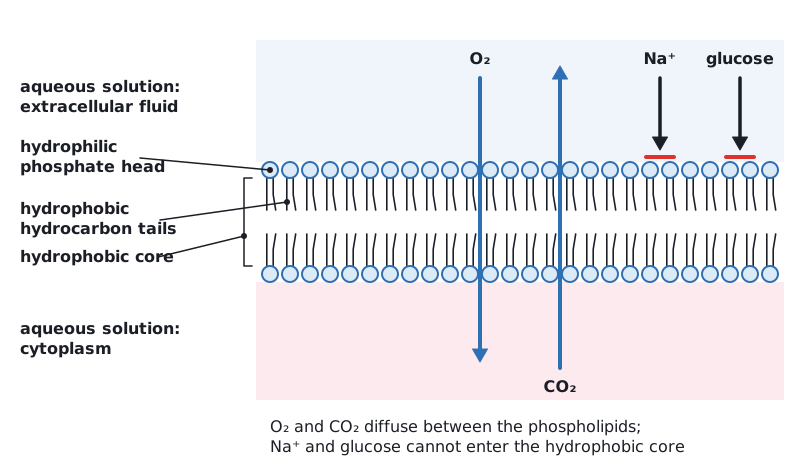
A lipid bilayer is a double layer of amphipathic phospholipids that forms naturally in water, with hydrophilic phosphate heads facing the water on both sides and hydrophobic hydrocarbon tails forming the core. The core has low permeability to ions, polar molecules and large molecules, but small non-polar molecules such as oxygen and carbon dioxide cross it by simple diffusion.
A phospholipid is amphipathic: it has a hydrophilic (water-attracting) phosphate head and two hydrophobic (water-repelling) hydrocarbon tails. Other membrane lipids, such as cholesterol and glycolipids, are also amphipathic.
In water, phospholipids naturally arrange themselves into a lipid bilayer. The heads face outwards into the water on both sides and the tails point inwards, away from the water. The bilayer forms continuous sheets, which close up so that no tails are left exposed at an edge. No energy input is needed. This bilayer is the basis of every cell membrane.
 (opens full size in a new tab)
Bilayers as barriers
The hydrocarbon chains that form the core of the membrane are non-polar. Hydrophilic particles cannot easily enter this region, so the core has low permeability to large molecules and to hydrophilic particles, including ions (such as Na⁺ and Cl⁻) and polar molecules (such as glucose). Membranes are therefore effective barriers between two aqueous solutions, such as the cytoplasm and tissue fluid.
| Particle | Example | Crosses the hydrophobic core? |
|---|---|---|
| Small non-polar molecule | O₂, CO₂ | Yes, readily |
| Small polar molecule | H₂O | Slowly |
| Large polar molecule | Glucose | Hardly at all |
| Ion | Na⁺, K⁺, Cl⁻ | Hardly at all (charged) |
Simple diffusion
Simple diffusion is the net movement of particles from a region of higher concentration to a region of lower concentration, caused by their random movement. It is passive: no energy from ATP is used. Oxygen and carbon dioxide are small and non-polar, so they diffuse directly between the phospholipids. In a respiring cell oxygen is used up, so it diffuses in; carbon dioxide is produced, so it diffuses out.
Particles do not move because of the gradient. They move randomly in all directions, but more cross from the side with the higher concentration, so the net movement is down the gradient.
Written and checked against the IB Biology HL specification · Updated October 2026