
Water as the medium for life and hydrogen bondingSpec A1.1.1, A1.1.2
In short
Water is the medium for life: the first cells originated in water and most processes of life still happen in aqueous solution. Oxygen attracts the shared electrons more strongly than hydrogen, so the O–H bonds are polar covalent, and hydrogen bonds form between the slightly positive hydrogen of one molecule and the slightly negative oxygen of another.
Water as the medium for life
The first cells originated in water, and water remains the medium in which most processes of life occur. Cytoplasm is mostly water, metabolic reactions take place in aqueous solution, and substances are carried around organisms dissolved in water (blood plasma, xylem sap, phloem sap).
Polar covalent bonds
A water molecule (H₂O) has two covalent bonds between oxygen and hydrogen. The electrons in each bond are shared unequally: the oxygen nucleus attracts them more strongly than the hydrogen nuclei. So the oxygen end carries a partial negative charge (δ−) and each hydrogen carries a partial positive charge (δ+). Because the molecule is bent rather than straight, the charges do not cancel, and the whole molecule is polar.
Hydrogen bonds between water molecules
A hydrogen bond is the attraction between the δ+ hydrogen of one water molecule and the δ− oxygen of a neighbouring water molecule. It is an intermolecular force, much weaker than a covalent bond, but there are vast numbers of them in liquid water. They constantly break and re-form, and together they explain cohesion, adhesion, the solvent properties and the high specific heat capacity of water.
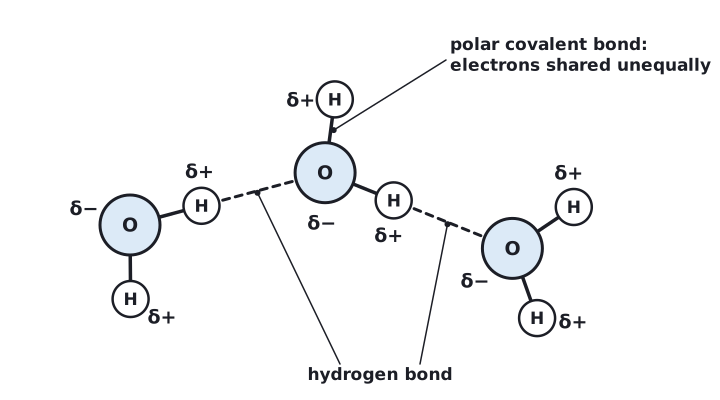 (opens full size in a new tab)
When asked to draw hydrogen bonding, draw at least two water molecules, show δ+ on hydrogens and δ− on oxygen, and use a dashed line from H to O. In water, hydrogen bonds form between molecules, not within one.
Polarity is caused by unequal sharing of electrons in the covalent bond, not by water having ions. Water molecules are uncharged overall.
Written and checked against the IB Biology HL specification · Updated October 2026