
Homeostasis and negative feedbackSpec D3.3.1, D3.3.2
In short
Homeostasis is the maintenance of the internal environment of an organism: variables are kept within preset limits despite fluctuations in the external environment. In humans these include body temperature, blood pH, blood glucose concentration and blood osmotic concentration. Negative feedback returns a variable to its set point whether it rises above or falls below it.
Homeostasis is the maintenance of the internal environment of an organism. Variables are kept within preset limits, despite fluctuations in the external environment, so that cells, and especially enzymes, work reliably.
| Variable | Approximate normal value |
|---|---|
| Body (core) temperature | About 37 °C |
| Blood pH | 7.35–7.45 |
| Blood glucose concentration | About 4–6 mmol L⁻¹ when fasting |
| Blood osmotic concentration | About 0.3 osmol L⁻¹ |
Negative feedback loops
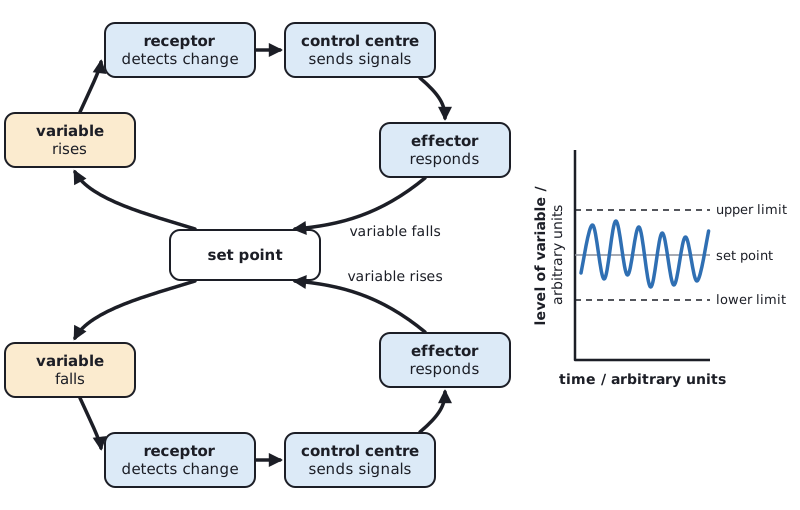
- A receptor detects a change in a variable away from its set point.
- A control centre (often in the brain or an endocrine gland) compares it with the set point and sends signals by nerves or hormones.
- Effectors (muscles or glands) respond.
- The response reverses the change, returning the variable to the set point. The loop then switches off.
- Negative feedback works in both directions: it brings a variable down when it is above the set point and up when it is below it.
- Positive feedback amplifies a change away from the set point, so it would make an imbalance worse. That is why homeostasis uses negative feedback; positive feedback is only useful for events that must be completed quickly, such as childbirth.
 (opens full size in a new tab)
Negative feedback does not keep a variable perfectly constant: it fluctuates slightly around the set point within preset limits.
Written and checked against the IB Biology HL specification · Updated October 2026