
Meiosis, non-disjunction and variationSpec D2.1.9, D2.1.10, D2.1.11
In short
Meiosis is a reduction division: two divisions turn one diploid nucleus into four haploid nuclei. Homologous chromosomes separate in meiosis I and sister chromatids in meiosis II. Errors such as non-disjunction cause conditions like Down syndrome. Crossing over and random orientation of bivalents make every haploid nucleus genetically different.
- Diploid (2n)
- A nucleus with two of each type of chromosome, one from each parent (two full sets). Human body cells have 46 chromosomes.
- Haploid (n)
- A nucleus with one of each type of chromosome (one full set). Human gametes have 23 chromosomes.
- Homologous chromosomes
- A pair of chromosomes with the same genes in the same sequence, but not necessarily the same alleles.
- Bivalent
- A pair of homologous chromosomes held together during meiosis I.
Meiosis is a reduction division: one diploid nucleus divides twice to give four haploid nuclei. It is needed in a sexual life cycle because fertilisation joins two gametes. If gametes were diploid, the chromosome number would double every generation. Halving it in meiosis keeps the number constant from one generation to the next.
Two rounds of segregation
- DNA is replicated before meiosis, so each chromosome consists of two sister chromatids.
- Meiosis I: homologous chromosomes pair up to form bivalents, and crossing over can occur. Bivalents line up on the equator. The homologous chromosomes separate to opposite poles (first segregation). Each of the two nuclei is haploid, but each chromosome still has two chromatids.
- Meiosis II: in each of the two cells the chromosomes line up on the equator and the sister chromatids separate to opposite poles (second segregation).
- Result: four haploid nuclei, each with one chromosome of every type, all genetically different.
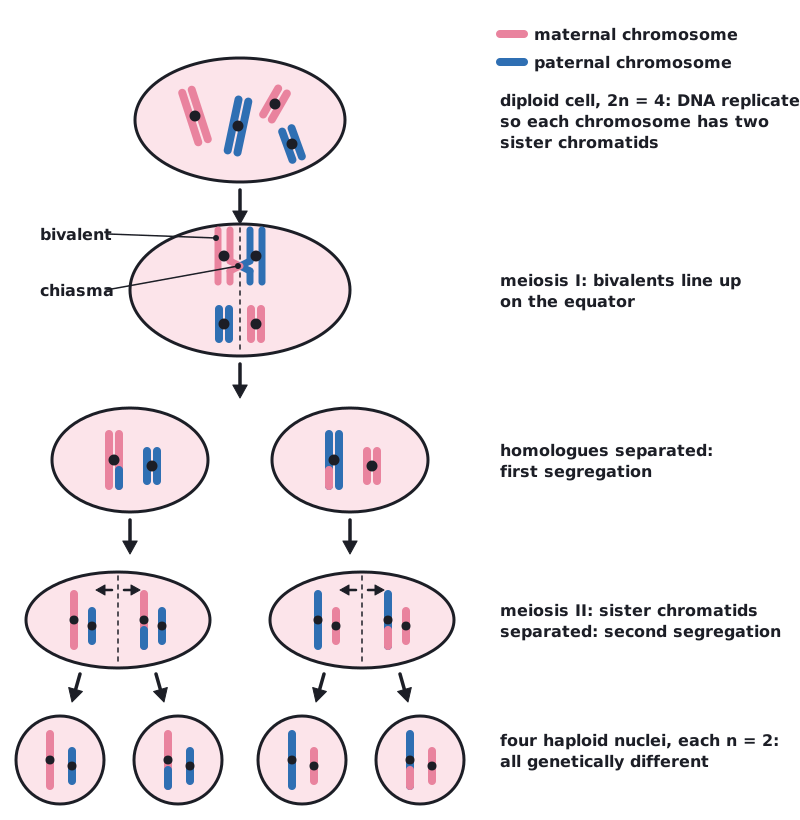 (opens full size in a new tab)
Down syndrome and non-disjunction
Non-disjunction is the failure of chromosomes to separate correctly in meiosis. Either a pair of homologous chromosomes fails to separate in meiosis I, or a pair of sister chromatids fails to separate in meiosis II. One gamete then has an extra chromosome and another has one missing.
Down syndrome is an example of an error in meiosis. If a gamete with two copies of chromosome 21 (24 chromosomes) is fertilised by a normal gamete (23), the zygote has three copies of chromosome 21 (trisomy 21) and 47 chromosomes in every cell.
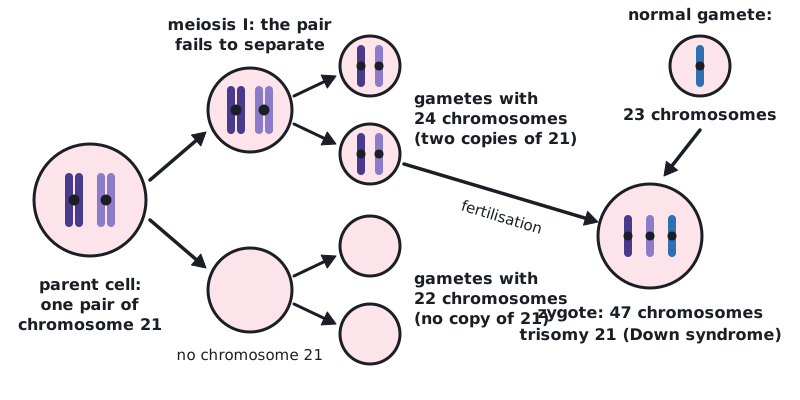 (opens full size in a new tab)
Meiosis as a source of variation
- Crossing over in prophase I: non-sister chromatids of a bivalent exchange sections at a chiasma. This creates chromatids with new combinations of alleles of linked genes.
- Random orientation of bivalents in metaphase I: each bivalent lines up independently of the others, so the maternal or paternal chromosome of each pair can face either pole. With n pairs there are 2ⁿ possible combinations; in humans 2²³, which is about 8.4 million.
Linking question: how does the variation produced by sexual reproduction contribute to evolution? Meiosis and random fertilisation produce new allele combinations, giving natural selection variation to act on (D4.1).
Written and checked against the IB Biology HL specification · Updated October 2026