
Directionality and purine–pyrimidine pairingSpec A1.2.11, A1.2.12
In short
Nucleic acid strands have directionality because each phosphate links carbon 3' of one sugar to carbon 5' of the next, giving a 5' end and a 3' end. New strands are built only 5' to 3', and ribosomes read mRNA 5' to 3'. Each base pair is a purine with a pyrimidine, so the helix is uniform.
Directionality of RNA and DNA
The carbons of the pentose sugar are numbered 1' to 5'. The base is attached to carbon 1', the phosphate of the same nucleotide to carbon 5', and the phosphate of the next nucleotide to carbon 3'. So every link in the backbone runs from carbon 3' of one sugar to carbon 5' of the next. One end of a strand has a free phosphate on carbon 5' (the 5' end) and the other a free OH on carbon 3' (the 3' end). In DNA the two strands run in opposite directions: this is what antiparallel means.
| Process | Significance of 5' to 3' |
|---|---|
| Replication | DNA polymerase can only add nucleotides to the 3' end of a growing strand, so new DNA is built 5' to 3' |
| Transcription | RNA polymerase builds mRNA 5' to 3', so it moves along the template strand reading it 3' to 5' |
| Translation | Ribosomes read mRNA from the 5' end towards the 3' end, codon by codon |
Purine-to-pyrimidine bonding
Adenine and guanine are purines, with two rings. Cytosine, thymine and uracil are pyrimidines, with one ring. Each base pair in DNA is one purine bonded to one pyrimidine (A–T and C–G), so all base pairs have equal length. The two backbones are therefore always the same distance apart and the DNA helix has the same three-dimensional structure, regardless of the base sequence. This uniformity contributes to the stability of the helix.
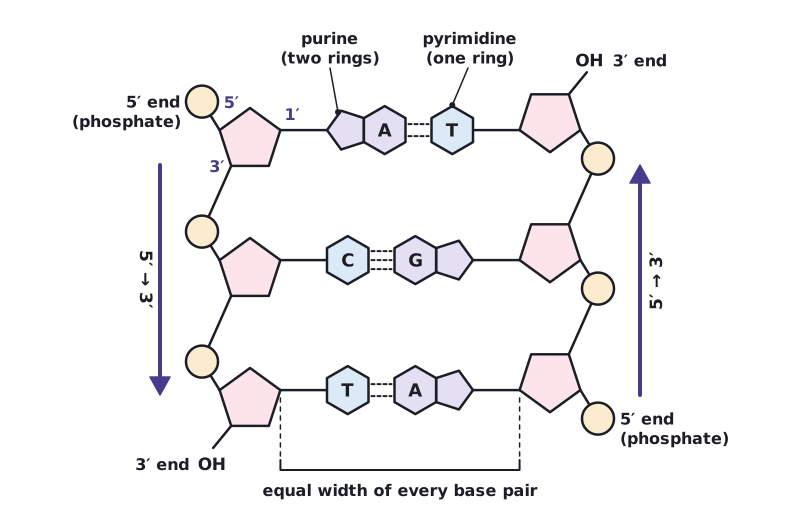 (opens full size in a new tab)
A purine never pairs with a purine. Two purines would be too wide to fit between the backbones and two pyrimidines too narrow.
Written and checked against the IB Biology HL specification · Updated October 2026