
Vesicles and RNA as the first genetic materialSpec A2.1.5, A2.1.6
In short
Fatty acids coalesce spontaneously in water into spherical bilayers called vesicles, creating a membrane-bound compartment whose internal chemistry can differ from the outside. RNA is presumed to have been the first genetic material because it can be replicated and has some catalytic activity, so it could act as both genes and enzymes. Ribozymes in ribosomes still catalyse peptide bond formation.
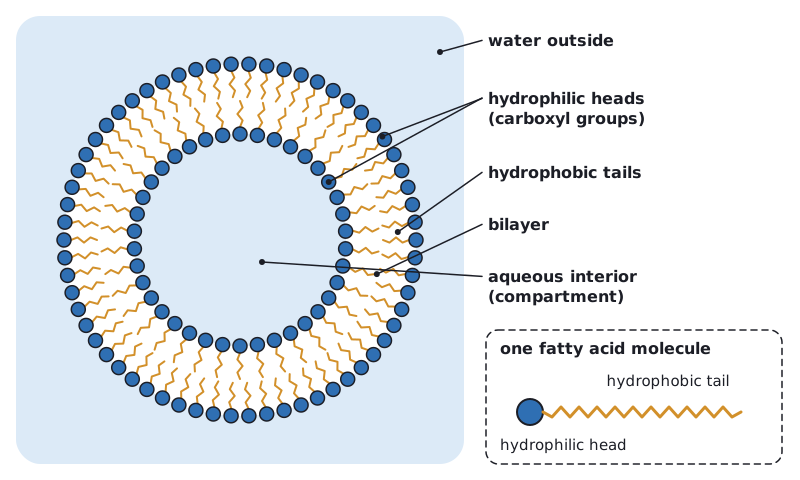
Fatty acids are amphipathic: each has a hydrophilic carboxyl head and a long hydrophobic hydrocarbon tail. In water they coalesce spontaneously into spherical bilayers, with the heads facing the water inside and outside and the tails hidden in the middle. These hollow spheres are vesicles.
No enzymes or energy input are needed: the bilayer forms because the hydrophobic tails are excluded from water, and closing into a sphere leaves no exposed edges.
- Formation of a membrane-bound compartment allows internal chemistry to become different from that outside the compartment.
- Molecules such as RNA can be concentrated inside, so they meet and react more often.
- Fatty acid vesicles can grow by taking in more fatty acids and can divide, a simple model of how protocells might have reproduced.
 (opens full size in a new tab)
RNA as a presumed first genetic material
Modern cells store information in DNA and use proteins as enzymes, but each depends on the other: DNA is needed to make proteins, and proteins are needed to copy DNA. RNA can do both jobs, so it is presumed to have been the first genetic material, an idea called the RNA world hypothesis.
| Property of RNA | Why it matters |
|---|---|
| Stores information in its base sequence | It can act as genes |
| Can be replicated by complementary base pairing | Information can be copied and inherited |
| Has some catalytic activity (ribozymes) | It can act as an enzyme, possibly even helping to catalyse its own replication |
Evidence: ribozymes in the ribosome are still used to catalyse peptide bond formation during protein synthesis. The catalytic site of the ribosome is made of rRNA, not protein. Later, DNA (more stable) probably took over information storage, and proteins (more varied and better catalysts) took over most catalysis.
Linking question: for what reasons is heredity an essential feature of living things? Self-replicating RNA gave the first heritable variation for natural selection to act on.
Written and checked against the IB Biology HL specification · Updated October 2026