Ecological succession and primary succession

Ecosystems (Continuity and change) · Stability and change · note 9 of 10

Spec D4.2.12, D4.2.13
HL only (what this means)HL only: additional Higher Level content, only for HL students. SL students can skip it. What the labels mean
Download all Stability and change notes (PDF)Download all notes (PDF)10 pages

Ecological succession and primary successionSpec D4.2.12, D4.2.13

In short

Ecological succession is the sequence of changes in a community over time. It can be triggered by changes in both the abiotic environment and biotic factors. During primary succession on new land, such as sand dunes, the size of plants, primary production, species diversity, complexity of food webs and nutrient cycling all increase.

Ecological succession is a sequence of changes in the community of an area over time. It can be triggered by changes in the abiotic environment, for example new land exposed by a retreating glacier or deposited as sand dunes, and by biotic factors, for example organisms forming soil, casting shade or adding nitrogen, so that conditions suit different species.

Primary succession starts on land with no soil. Secondary succession starts where soil remains after a disturbance, such as a fire.

Example: sand dune succession

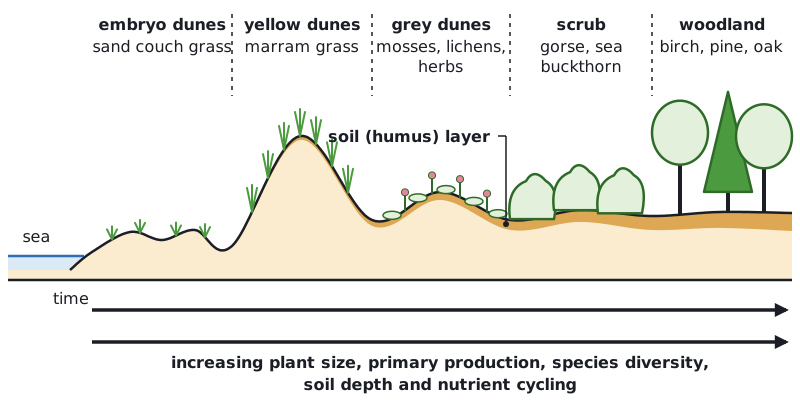
  1. Pioneer species such as sand couch grass tolerate salt spray and wind and colonise bare sand above the high-tide line.
  2. Their roots trap sand; marram grass grows up through new sand and stabilises taller dunes.
  3. Dead plant matter adds humus, so the soil holds more water and nutrients; mosses, lichens and many herbs colonise.
  4. Shrubs such as gorse and sea buckthorn grow in the deeper soil and shade out low plants.
  5. Woodland of trees such as birch, pine and oak develops.
General changes during primary succession
FeatureChange
Size of plantsIncreases, from low pioneers to shrubs and trees
Amount of primary productionIncreases
Species diversityIncreases
Complexity of food websIncreases, with more trophic links
Amount of nutrient cyclingIncreases, as more organic matter is decomposed and soil deepens
Sand dune profile from the sea inland: embryo dunes (sand couch grass), yellow dunes (marram grass), grey dunes (mosses, lichens, herbs), scrub (gorse, sea buckthorn) and woodland (birch, pine, oak), with a soil (humus) layer thickening inland; arrows show time and increasing plant size, primary production, species diversity, soil depth and nutrient cycling. (opens full size in a new tab)
Primary succession on sand dunes: moving inland means moving forward in time.

Written and checked against the IB Biology HL specification · Updated October 2026

Frequently asked questions

What is a tipping point in an ecosystem?

A tipping point is a critical threshold beyond which a small further change causes a large, often irreversible, shift to a different state. In the Amazon, deforestation reduces transpiration and rainfall; past an uncertain minimum forest area, drought and fire could change the rainforest into savannah.

What is eutrophication and what causes it?

Eutrophication is the enrichment of water with nutrients, caused mainly by leaching of nitrogen and phosphate fertilizers. Algae grow rapidly and block light, so plants die. Decomposers break down the dead matter by aerobic respiration, raising biochemical oxygen demand, so dissolved oxygen falls and fish die.

Why do top predators have the highest levels of DDT and mercury?

Top predators have the highest levels because of biomagnification. DDT and mercury are persistent and fat-soluble, so they are stored rather than excreted. Each consumer eats many prey and keeps their toxin, so the concentration rises at every trophic level and is greatest in the highest one.

All 5 questions on Stability and change