
Exogenous chemicals, inhibition and summationSpec C2.2.12, C2.2.13, C2.2.14
In short
Exogenous chemicals from outside the body can alter synaptic transmission: neonicotinoid pesticides block transmission at insect acetylcholine synapses, and cocaine blocks reuptake of dopamine. Inhibitory neurotransmitters hyperpolarize the postsynaptic membrane, producing inhibitory postsynaptic potentials. A postsynaptic neuron sums excitatory and inhibitory inputs and fires only if the threshold potential is reached.
Effects of exogenous chemicals
| Chemical | Action at the synapse | Consequence |
|---|---|---|
| Neonicotinoids (pesticides) | Bind to acetylcholine receptors in the postsynaptic membrane of insect neurons. Unlike acetylcholine, they are not broken down by the enzyme in the synaptic cleft, so they stay bound and block synaptic transmission. | Paralysis and death of insects. They bind far more strongly to insect receptors than to mammalian ones, but they also harm useful insects such as bees. |
| Cocaine (drug) | Binds to the transporter proteins that take dopamine back into the presynaptic neuron, blocking reuptake of the neurotransmitter. | Dopamine builds up in the cleft and keeps stimulating postsynaptic neurons in the brain's reward pathways, causing euphoria and addiction. |
Inhibitory postsynaptic potentials
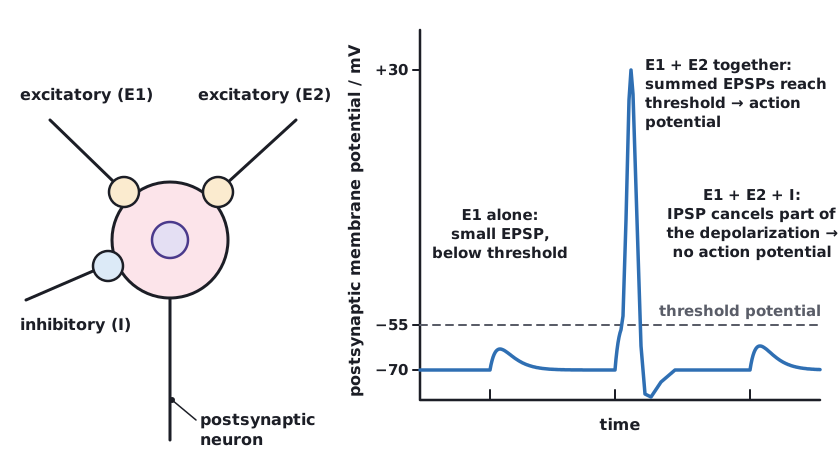
Inhibitory neurotransmitters, such as GABA, bind to receptors that let negative ions (Cl⁻) in or positive ions (K⁺) out. The postsynaptic membrane becomes hyperpolarized: more negative than the resting potential. This inhibitory postsynaptic potential (IPSP) moves the membrane further from threshold, so an action potential is less likely.
Summation
- A postsynaptic neuron may receive synapses from many presynaptic neurons, some excitatory and some inhibitory.
- One EPSP is usually too small to reach threshold on its own.
- The effects add together (summation): EPSPs depolarize, IPSPs hyperpolarize, and the net change decides the outcome.
- The result is all-or-nothing: if the combined depolarization reaches the threshold potential, an action potential is generated; if not, there is no action potential.
 (opens full size in a new tab)
For an IPSP the guide's key word is hyperpolarized. Say the inside becomes more negative and the threshold is harder to reach.
Written and checked against the IB Biology HL specification · Updated October 2026