
Tertiary structure and the effect of polar and non-polar amino acidsSpec B1.2.9, B1.2.10
In short
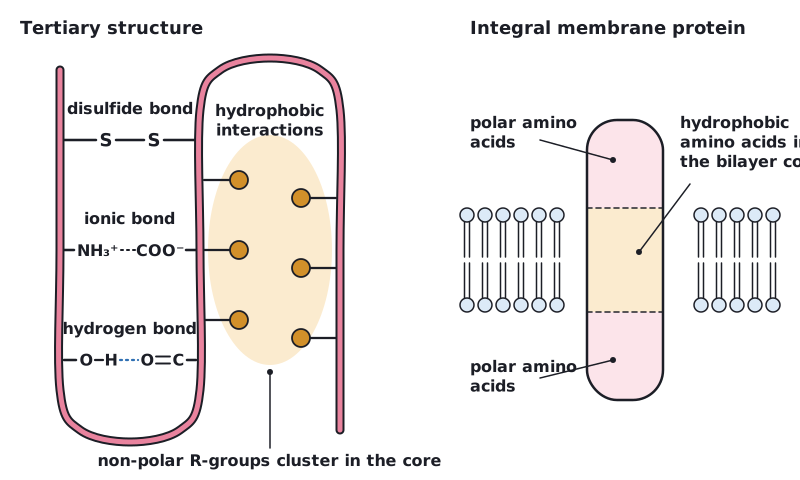
Tertiary structure is the overall three-dimensional folding of a polypeptide. It depends on interactions between R-groups: hydrogen bonds, ionic bonds, disulfide covalent bonds between pairs of cysteines, and hydrophobic interactions. In water-soluble globular proteins, hydrophobic amino acids cluster in the core, while integral membrane proteins have hydrophobic regions that embed in the membrane.
A polypeptide folds further into a specific three-dimensional shape, its tertiary structure. This is held by interactions between R-groups, which may be far apart in the sequence but end up close together after folding.
| Interaction | Between | Strength |
|---|---|---|
| Hydrogen bonds | Polar R-groups | Weak, but many of them |
| Ionic bonds | A positively charged R-group (–NH₃⁺) and a negatively charged R-group (–COO⁻) | Stronger than hydrogen bonds; sensitive to pH |
| Disulfide bonds | Sulfur atoms of two cysteine R-groups (–S–S–) | Covalent, so the strongest |
| Hydrophobic interactions | Non-polar R-groups clustering together away from water | Weak individually, important overall |
Amine and carboxyl groups in R-groups become charged by binding or dissociation of hydrogen ions: –NH₂ gains H⁺ to become –NH₃⁺, and –COOH loses H⁺ to become –COO⁻. Opposite charges then attract to form ionic bonds. This is why pH affects tertiary structure.
A disulfide bond is a covalent bond between the sulfur atoms of a pair of cysteines. It forms between cysteines in the same chain or in different chains.
Polar and non-polar amino acids
- In proteins that are soluble in water, hydrophobic amino acids are clustered in the core of the globular protein, away from water. Polar and charged amino acids are on the surface, where they interact with water and keep the protein soluble.
- Integral membrane proteins have regions of hydrophobic amino acids that sit in the hydrophobic core of the phospholipid bilayer, helping them to embed in the membrane. Regions of polar amino acids face the water on either side.
 (opens full size in a new tab)
Written and checked against the IB Biology HL specification · Updated October 2026