
Approaches to conservation and the EDGE of Existence programmeSpec A4.2.7, A4.2.8
In short
Conservation of biodiversity needs several approaches, because no single approach is sufficient and different species need different measures. These include in situ conservation and nature reserves, rewilding and reclamation of degraded ecosystems, ex situ conservation in zoos and botanic gardens, and seed or tissue banks. The EDGE of Existence programme prioritises species that are evolutionarily distinct and globally endangered.
No single approach to conservation is sufficient by itself, and different species require different measures. A species with a large range needs protected habitat; one reduced to a few individuals may need captive breeding.
| Approach | What it involves | Strength or limitation |
|---|---|---|
| In situ conservation | Protecting species in their natural habitats | Keeps species interacting with their community and still evolving; fails if the habitat is too degraded |
| Management of nature reserves | Protecting and actively managing land or sea: controlling invasive species, preventing poaching, managing grazing and fire, linking reserves with corridors | Needs long-term funding and enforcement |
| Rewilding | Reintroducing lost species, often large herbivores or top predators, and letting natural processes restore the ecosystem | Wolves reintroduced to Yellowstone National Park in 1995 changed grazing by elk |
| Reclamation of degraded ecosystems | Restoring damaged land or water, for example replanting mangroves or re-flooding drained wetlands | Slow and costly, but recovers whole communities |
| Ex situ conservation in zoos | Captive breeding of threatened animals, then reintroduction | The Arabian oryx, extinct in the wild by 1972, was bred in captivity and reintroduced from 1982 |
| Botanic gardens | Growing rare plants away from their habitat | Small populations have low genetic diversity |
| Seed and tissue banks | Storing germ plasm: dried seeds kept cold, or tissue samples frozen | Stores huge genetic diversity in a small space, e.g. the Svalbard Global Seed Vault for crop seeds |
The EDGE of Existence programme
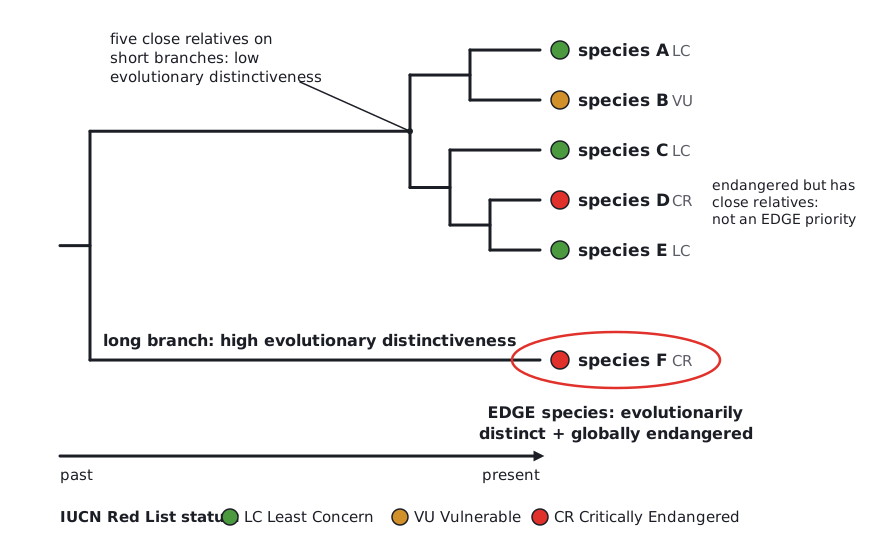
Conservation money and effort are limited, so species must be prioritised. The EDGE of Existence programme, run by the Zoological Society of London, focuses on species that are both Evolutionarily Distinct and Globally Endangered.
- Evolutionarily distinct (ED): the species has few or no close living relatives, so it sits at the end of a long branch of the evolutionary tree and represents a lot of unique evolutionary history.
- Globally endangered (GE): the species is at high risk of extinction, judged by its IUCN Red List category.
- A species scoring high on both is an EDGE species and a high priority.
The rationale: if a species with no close relatives becomes extinct, a disproportionate amount of unique genes, features and evolutionary history is lost, and no similar species remains. Many EDGE species, such as the aye-aye of Madagascar, the Chinese giant salamander, pangolins and the gharial, receive little attention from other programmes.
 (opens full size in a new tab)
Nature of science: deciding which species to prioritise has ethical, environmental, political, social, cultural and economic implications. In discuss questions, give arguments for and against the EDGE approach.
Quick check
Name the three levels of biodiversity.
Show answer
Ecosystem diversity, species diversity and genetic diversity.
What does fossil evidence suggest about the number of species alive today?
Show answer
There are more species alive today than at any time in the past.
Why must biodiversity surveys be repeated?
Show answer
To provide evidence of change in species richness and evenness over time.
What is the overarching cause of the current biodiversity crisis?
Show answer
Human population growth.
What does EDGE stand for?
Show answer
Evolutionarily distinct and globally endangered.
Written and checked against the IB Biology HL specification · Updated October 2026