
Modification of polypeptides and proteasomesSpec D1.2.18, D1.2.19
In short
Many polypeptides must be modified before they can function. Insulin is made in two stages: the signal sequence is removed from pre-proinsulin to give proinsulin, which folds and forms disulfide bonds, then the C-peptide is cut out, leaving two chains. Proteasomes break down proteins into short peptides, so amino acids are recycled and a functional proteome is sustained.
The polypeptide released from the ribosome is often not yet functional. It may need to be folded, cut, joined to other polypeptides or have other groups (such as carbohydrates) added.
Pre-proinsulin to insulin
- Translation on ribosomes of the rough endoplasmic reticulum produces pre-proinsulin. It has a signal sequence at its amine end that directs it into the endoplasmic reticulum.
- Stage 1: the signal sequence is removed in the endoplasmic reticulum, giving proinsulin. Proinsulin folds and three disulfide bonds form.
- Stage 2: in the Golgi apparatus and secretory vesicles, enzymes cut out the middle section, the C-peptide.
- The remaining two chains, the A chain (21 amino acids) and B chain (30 amino acids), stay linked by disulfide bonds. This is active insulin, which is secreted.
Recycling of amino acids by proteasomes
The proteome is the set of all proteins produced by a cell. Proteins are constantly being damaged or misfolded, or are no longer needed. Such proteins are first tagged for destruction (with a small protein called ubiquitin). Proteasomes, large barrel-shaped protein complexes in the cytoplasm and nucleus, recognise the tag and hydrolyse the tagged protein into short peptides. Other enzymes (peptidases) break the peptides into amino acids, which are reused in protein synthesis.
Sustaining a functional proteome requires constant protein breakdown and synthesis. Breakdown removes faulty proteins and allows the cell to change which proteins it contains as conditions change.
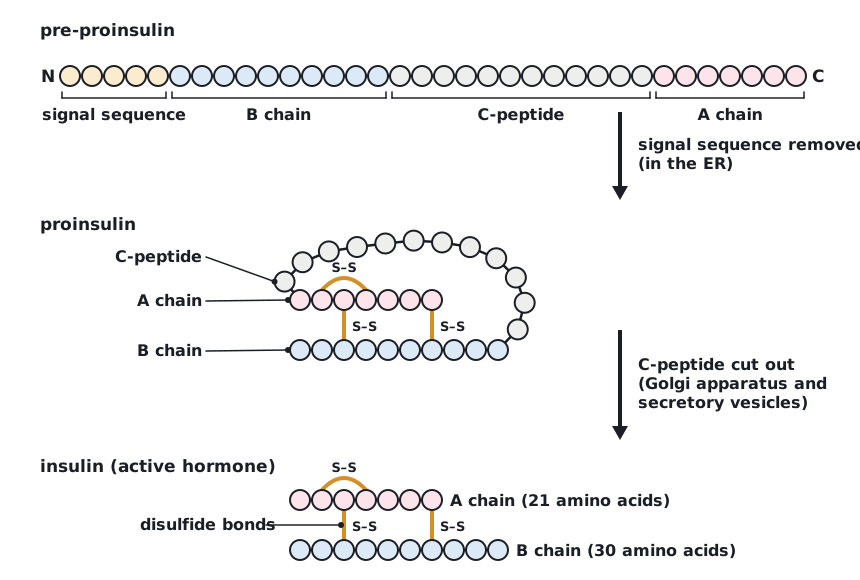 (opens full size in a new tab)
Insulin is two polypeptide chains, but they come from a single gene and a single polypeptide (pre-proinsulin). The chains are separated by cutting, not translated separately.
Quick check
Which base on RNA pairs with adenine on the DNA template strand?
Show answer
Uracil.
Why must DNA in non-dividing somatic cells stay unchanged by transcription?
Show answer
The same sequences must be transcribed throughout the life of the cell, so they must be conserved.
What is meant by the degeneracy of the genetic code?
Show answer
More than one codon can code for the same amino acid.
How many tRNAs can bind to the large ribosomal subunit at once?
Show answer
Two.
HL only What is removed from proinsulin to produce insulin?
Show answer
The C-peptide.
Written and checked against the IB Biology HL specification · Updated October 2026