
Tropic responses in seedlings and positive phototropismSpec C3.1.17, C3.1.18
In short
Positive phototropism is a directional growth response to lateral light in plant shoots: the shoot grows towards the light. Tropic responses can be observed in seedlings and recorded qualitatively with diagrams or quantitatively by measuring the angle of curvature. Precision, accuracy and reliability are improved by careful measurement, large samples and repeats.
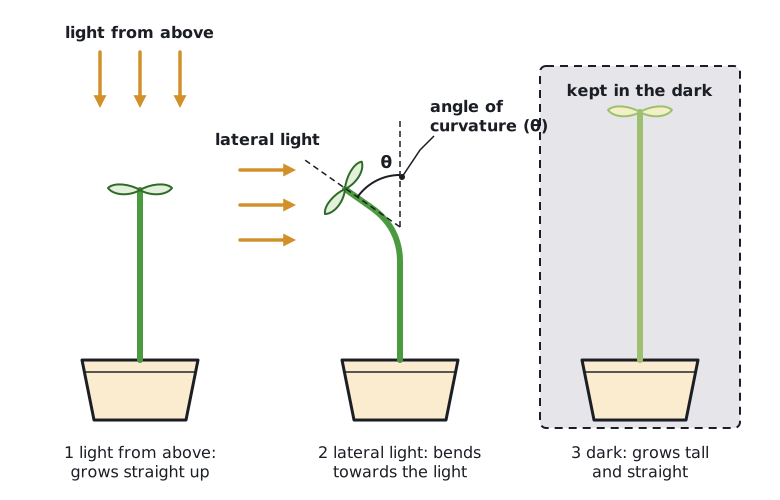
A tropism is a directional growth response to a directional stimulus. Positive phototropism is a directional growth response to lateral light in plant shoots: the shoot grows towards the side the light comes from. This places leaves where they absorb more light for photosynthesis.
Grow seedlings (for example cress, mustard or oat) in a box lit from one side, with controls lit from above or kept in the dark. Record qualitative data with labelled diagrams; collect quantitative data by measuring the angle of curvature of each seedling with a protractor or from a photograph.
Qualitative and quantitative observations
- Qualitative observations describe without numbers: for example a drawing showing that shoots bend towards the light.
- Quantitative observations are measurements: for example the angle of curvature in degrees after 24 hours.
Precision, accuracy and reliability
- Precision is limited by the resolution of the protractor and by deciding exactly where the curved shoot begins. Photographing seedlings against a grid and measuring angles with image-analysis software increases precision.
- Accuracy is improved by measuring from a fixed reference line (the original vertical) and photographing from directly side-on.
- Reliability is improved by using many seedlings per treatment, repeating the experiment and calculating means; controlling light intensity, temperature and water.
 (opens full size in a new tab)
You only need phototropism. Specific examples of other tropisms are not required.
Written and checked against the IB Biology HL specification · Updated October 2026