
Speed of nerve impulsesSpec C2.2.4, C2.2.11
In short
Nerve impulses travel faster along wider axons and much faster along myelinated fibres. The giant axons of squid conduct faster than smaller non-myelinated fibres, but narrow myelinated fibres are faster still. At HL, myelinated fibres achieve faster impulses by saltatory conduction: the action potential jumps from one node of Ranvier to the next.
The speed of nerve impulses varies a lot between nerve fibres. Two factors matter most: axon diameter and myelination.
| Fibre | Diameter | Approximate speed |
|---|---|---|
| Small non-myelinated fibre | About 1 µm | About 1 m s⁻¹ |
| Squid giant axon (non-myelinated) | Up to about 0.5–1 mm | About 25 m s⁻¹ |
| Myelinated vertebrate fibre | About 10–20 µm | Up to about 100 m s⁻¹ |
- Squid giant axons vs smaller non-myelinated fibres: a wider axon has less resistance to the flow of ions inside it, so local currents spread further and faster. The giant axon allows a rapid escape response.
- Myelinated vs non-myelinated fibres: myelinated fibres conduct far faster, even when much narrower, so many fast fibres fit into a small nerve.
Correlation and the coefficient of determination
- A positive correlation: one variable rises as the other rises, e.g. conduction speed and axon diameter.
- A negative correlation: one variable falls as the other rises. The guide's example is conduction speed and animal size. Published data for this vary between groups of animals, so in an exam describe the trend that the data you are given actually show.
- The correlation coefficient, r, runs from −1 to +1. Values near ±1 show a strong correlation; values near 0 show little or none.
- The coefficient of determination, R², is r squared. It gives the proportion of the variation in the dependent variable that is explained by variation in the independent variable.
- Correlation does not by itself show causation.
Using r and R²
For a set of non-myelinated axons, the correlation coefficient between axon diameter and conduction speed is r = 0.90. Calculate R² and interpret it.
- R² = r² = 0.90²
- R² = 0.81
- 0.81 = 81%: 81% of the variation in conduction speed is explained by variation in axon diameter.
- The other 19% is due to other factors, such as temperature or measurement error.
Answer: R² = 0.81; a strong positive correlation, with 81% of the variation in speed explained by diameter
State the direction (positive or negative) and strength of a correlation from r. Use R² only to say how much of the variation is explained, and never claim it proves cause.
HL only (what this means)
HL only: additional Higher Level content, only for HL students. SL students can skip it. What the labels meanSaltatory conduction
HL only (what this means)
HL only: additional Higher Level content, only for HL students. SL students can skip it. What the labels meanIn myelinated fibres the axon is wrapped in a myelin sheath that insulates it, with small gaps called nodes of Ranvier. The ion pumps and channels are clustered at the nodes, so an action potential can only occur there.
HL only (what this means)
HL only: additional Higher Level content, only for HL students. SL students can skip it. What the labels mean- An action potential occurs at one node.
- Local currents spread inside the axon, under the myelin, to the next node.
- The next node reaches threshold, its voltage-gated sodium channels open and an action potential occurs there.
- The action potential is propagated from node to node. This saltatory conduction is much faster than continuous propagation along the whole membrane.
HL only (what this means)
HL only: additional Higher Level content, only for HL students. SL students can skip it. What the labels mean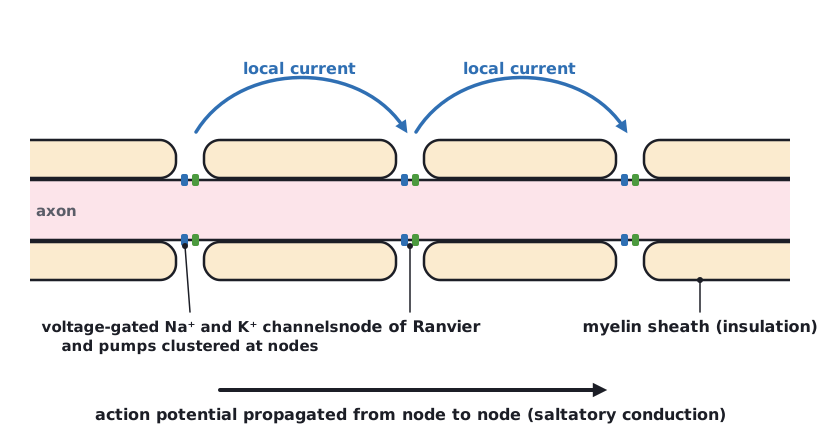 (opens full size in a new tab)
Written and checked against the IB Biology HL specification · Updated October 2026