
Eutrophication

Ecosystems (Continuity and change) · Stability and change · note 5 of 10

EutrophicationSpec D4.2.8

In short

Eutrophication is the enrichment of aquatic and marine ecosystems with nutrients, here from leaching of nitrogen and phosphate fertilizers. Algae grow rapidly, block light and die. Decomposers breaking down the dead matter respire aerobically, increasing biochemical oxygen demand (BOD). Oxygen levels fall and fish and other animals die.

Eutrophication is the enrichment of water with nutrients. Nitrogen and phosphate fertilizers leach out of farmland and run into rivers, lakes and coastal seas.

  1. Nitrate and phosphate leach from fields into the water.
  2. Algae and other producers grow rapidly, forming an algal bloom at the surface.
  3. The bloom blocks light, so plants below cannot photosynthesise and die; the short-lived algae die too.
  4. Bacteria decompose the dead organic matter, using oxygen in aerobic respiration.
  5. Biochemical oxygen demand rises and dissolved oxygen falls.
  6. Fish and other animals that need oxygen die, forming a low-oxygen 'dead zone'.
Biochemical oxygen demand (BOD)
The amount of dissolved oxygen used by microorganisms in a water sample over a set time while breaking down organic matter. A high BOD shows heavy organic pollution.
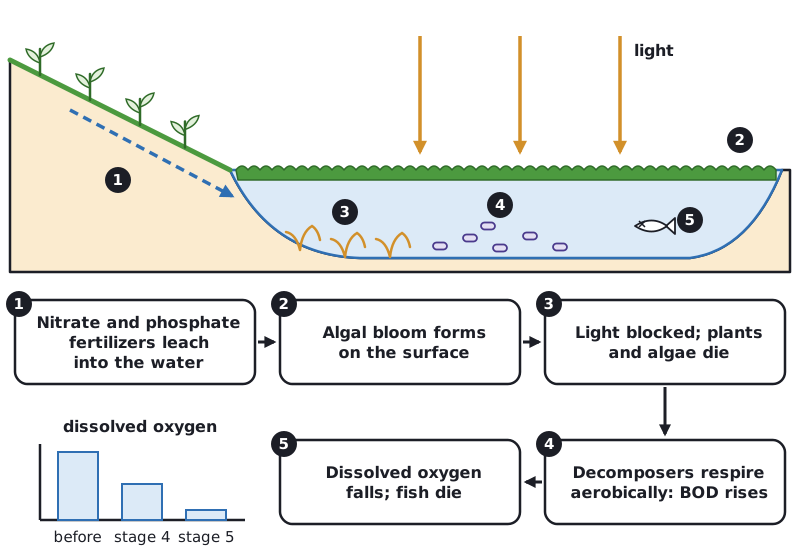
Farm field sloping into a lake with five numbered stages: nitrate and phosphate fertilizers leach into the water, algal bloom forms on the surface, light blocked so plants and algae die, decomposers respire aerobically and BOD rises, dissolved oxygen falls and fish die; a bar chart shows dissolved oxygen falling from before to stages 4 and 5. (opens full size in a new tab)
Eutrophication: decomposers raise biochemical oxygen demand, so dissolved oxygen falls and fish die.
Common mistake:

Fish die from lack of oxygen used up by decomposers, not because algae 'use up the oxygen' by photosynthesis. Algae produce oxygen while alive.

Written and checked against the IB Biology HL specification · Updated October 2026

Frequently asked questions

What is a tipping point in an ecosystem?

A tipping point is a critical threshold beyond which a small further change causes a large, often irreversible, shift to a different state. In the Amazon, deforestation reduces transpiration and rainfall; past an uncertain minimum forest area, drought and fire could change the rainforest into savannah.

What is eutrophication and what causes it?

Eutrophication is the enrichment of water with nutrients, caused mainly by leaching of nitrogen and phosphate fertilizers. Algae grow rapidly and block light, so plants die. Decomposers break down the dead matter by aerobic respiration, raising biochemical oxygen demand, so dissolved oxygen falls and fish die.

Why do top predators have the highest levels of DDT and mercury?

Top predators have the highest levels because of biomagnification. DDT and mercury are persistent and fat-soluble, so they are stored rather than excreted. Each consumer eats many prey and keeps their toxin, so the concentration rises at every trophic level and is greatest in the highest one.

All 5 questions on Stability and change