
Trophic levels and energy pyramidsSpec C4.2.10, C4.2.11
In short
A trophic level is the position of an organism in a food chain: producer, primary consumer, secondary consumer or tertiary consumer. Many organisms have a varied diet and occupy different trophic levels in different food chains. An energy pyramid shows the energy flowing through each trophic level per unit area per year, with bars drawn to scale.
| Trophic level | Name | Feeds on |
|---|---|---|
| 1 | Producer | Makes its own carbon compounds (autotroph) |
| 2 | Primary consumer | Producers |
| 3 | Secondary consumer | Primary consumers |
| 4 | Tertiary consumer | Secondary consumers |
Many organisms have a varied diet and occupy different trophic levels in different food chains. A red fox eating berries is a primary consumer; eating a hare it is a secondary consumer; eating an insect-eating bird it is a tertiary consumer.
Energy pyramids
An energy pyramid is a bar chart turned on its side, with one horizontal bar per trophic level, producers at the bottom. The width of each bar is proportional to the energy flowing through that level, in kJ m⁻² yr⁻¹. Energy pyramids are always pyramid-shaped, because energy is lost at every transfer.
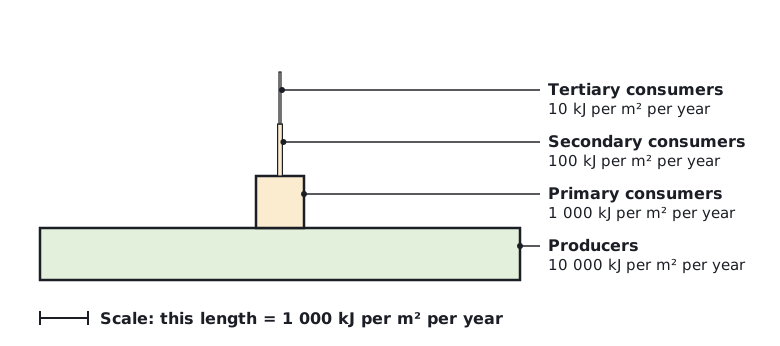 (opens full size in a new tab)
Percentage energy transfer
In a grassland (practice data), producers fix 25 000 kJ m⁻² yr⁻¹ and primary consumers take in 2 250 kJ m⁻² yr⁻¹. Calculate the percentage transfer.
- Percentage transfer = (energy at higher level ÷ energy at lower level) × 100.
- = (2 250 ÷ 25 000) × 100.
- = 9.0%.
Answer: 9.0% of the energy reaches the primary consumers.
When you construct an energy pyramid from research data, choose a scale so the smallest bar is still visible, label every level with its value and units, and centre the bars.
Written and checked against the IB Biology HL specification · Updated October 2026