
Organelles, the nucleus and compartmentsSpec B2.2.1–B2.2.3
In short
Organelles are discrete subunits of cells that are adapted to perform specific functions, such as nuclei, ribosomes, vesicles and the plasma membrane. Compartmentalization brings advantages: the nucleus separates transcription from translation so mRNA can be modified first, and lysosomes concentrate digestive enzymes while separating digestion from the rest of the cytoplasm.
Organelles are discrete subunits of cells that are adapted to perform specific functions. Nuclei, mitochondria, chloroplasts, the endoplasmic reticulum, the Golgi apparatus, vesicles, ribosomes and the plasma membrane are all organelles.
The cell wall, the cytoskeleton and the cytoplasm are not considered organelles. The wall lies outside the plasma membrane, the cytoskeleton is a network running through the whole cell, and the cytoplasm is the medium in which the organelles sit.
Cell fractionation
Progress in science often follows the development of new techniques. The functions of individual organelles could only be studied once ultracentrifuges had been invented and methods of using them for cell fractionation had been developed.
- Tissue is cut up and homogenised (blended) in a cold, isotonic, buffered solution to break the cells open.
- The homogenate is filtered to remove large debris.
- It is spun in a centrifuge at low speed. The largest, densest organelles (nuclei) form a pellet at the bottom of the tube.
- The liquid above the pellet (the supernatant) is spun at a higher speed to pellet chloroplasts (from plant tissue) and then mitochondria, then at even higher speeds in an ultracentrifuge for smaller parts such as fragments of ER and ribosomes.
- Each pellet is resuspended and tested, for example by measuring the activity of enzymes, to find out what that organelle does.
Cold slows enzymes that would digest the organelles, an isotonic solution stops organelles gaining or losing water by osmosis, and a buffer keeps the pH constant so proteins are not denatured.
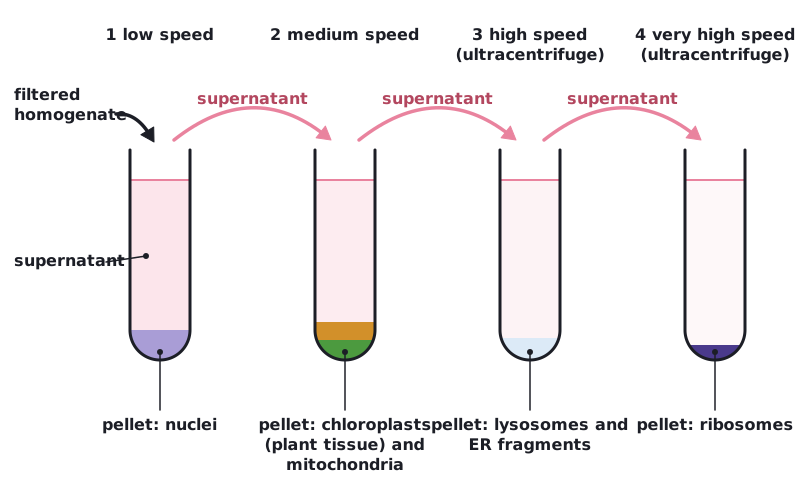 (opens full size in a new tab)
Separating the nucleus from the cytoplasm
In eukaryotes, transcription happens in the nucleus and translation happens at ribosomes in the cytoplasm. Because they are in separate compartments, post-transcriptional modification of mRNA (such as removing introns) can happen before the mRNA meets ribosomes. Prokaryotes have no nucleus, so mRNA may meet ribosomes immediately and translation can begin before transcription has finished.
Compartments in the cytoplasm
- Enzymes and their substrates (metabolites) can be concentrated in a small volume, so reactions are faster.
- Incompatible biochemical processes are kept apart, for example digestion of molecules and their synthesis.
- Conditions such as pH can be kept different in each compartment.
Lysosomes are vesicles containing hydrolytic enzymes that work best at acid pH. If these enzymes were free in the cytoplasm they would digest the cell's own molecules. Phagocytic vacuoles form when a cell such as a white blood cell engulfs a bacterium by endocytosis. Lysosomes then fuse with the vacuole, so the bacterium is digested inside a closed compartment.
Linking question: what separation techniques are used by biologists? Centrifugation separates cell parts by size and density; compare chromatography and gel electrophoresis, which separate molecules.
Written and checked against the IB Biology HL specification · Updated October 2026