
Initiation of translation and the A, P and E sites

Molecules (Continuity and change) · Protein synthesis · note 7 of 8

Spec D1.2.17
HL only (what this means)HL only: additional Higher Level content, only for HL students. SL students can skip it. What the labels mean
Download all Protein synthesis notes (PDF)Download all notes (PDF)11 pages

Initiation of translation and the A, P and E sitesSpec D1.2.17

In short

Initiation of translation begins when the small ribosomal subunit attaches to the 5' terminal of mRNA and moves to the start codon AUG. The initiator tRNA, carrying methionine, pairs with it and the large subunit attaches. During elongation, each tRNA enters the A site, holds the growing polypeptide in the P site and leaves from the E site.

Initiation

  1. The small ribosomal subunit attaches to the 5' terminal of the mRNA.
  2. It moves along the mRNA towards the 3' end until it reaches the start codon (AUG).
  3. The initiator tRNA, with anticodon UAC and carrying methionine, pairs with the start codon.
  4. The large subunit attaches, so the initiator tRNA occupies the P site.
  5. Another tRNA, with the anticodon complementary to the next codon, binds at the A site, and elongation begins.

The three tRNA binding sites

Roles of the tRNA binding sites during elongation
SiteRole
A site (aminoacyl)A tRNA carrying a single amino acid arrives and its anticodon pairs with the codon exposed there.
P site (peptidyl)Holds the tRNA attached to the growing polypeptide. The polypeptide is transferred to the amino acid on the tRNA in the A site by formation of a peptide bond.
E site (exit)After the ribosome moves one codon along, the tRNA that has given up its polypeptide moves to the E site and is released.

After each peptide bond forms, the ribosome moves along the mRNA by one codon. The tRNA in the A site, now carrying the polypeptide, moves to the P site; the empty tRNA moves from the P site to the E site and leaves; the A site is free for the next tRNA.
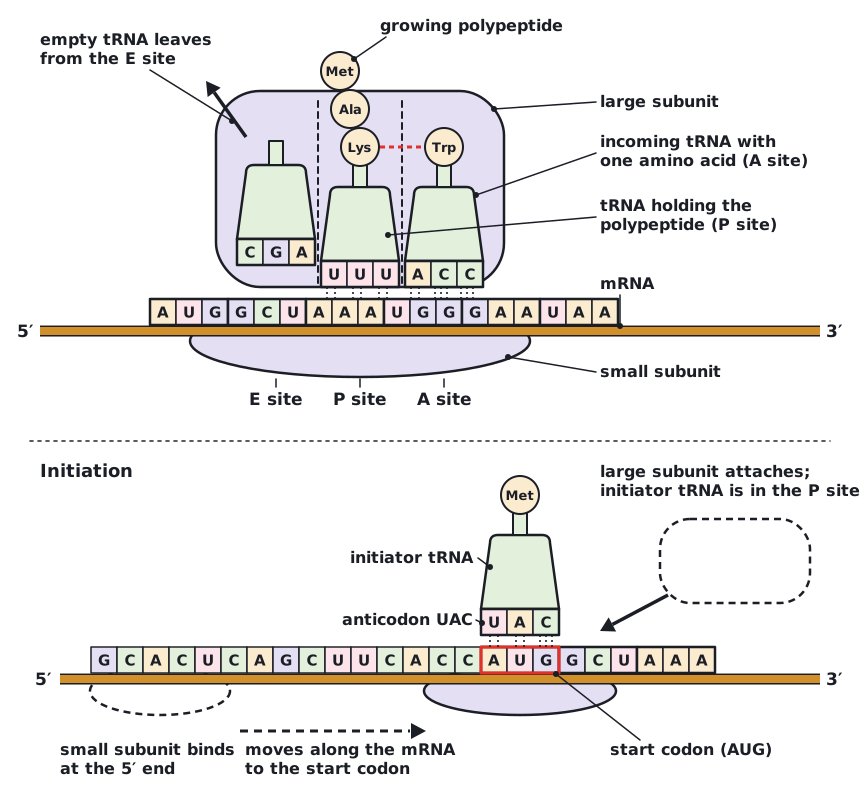
Ribosome on mRNA (5′ left, 3′ right) with the E, P and A sites: an empty tRNA leaves from the E site, the tRNA in the P site holds the growing polypeptide Met–Ala–Lys, and an incoming tRNA in the A site carries Trp; inset of initiation: the small subunit binds at the 5′ end, moves along to the start codon AUG, the initiator tRNA with anticodon UAC and methionine pairs with it, and the large subunit attaches. (opens full size in a new tab)
The A, P and E sites, and initiation at the start codon AUG.

Written and checked against the IB Biology HL specification · Updated October 2026

Frequently asked questions

What is the difference between transcription and translation?

Transcription is the synthesis of RNA using a DNA template, carried out by RNA polymerase in the nucleus of eukaryotes. Translation is the synthesis of a polypeptide from mRNA at a ribosome, where tRNA anticodons pair with mRNA codons and amino acids are joined by peptide bonds. Transcription copies the sequence; translation decodes it.

Why is the genetic code a triplet code?

The genetic code is a triplet code because there are four bases and twenty amino acids. Pairs of bases would give only 4² = 16 combinations, too few for twenty amino acids. Triplets give 4³ = 64 codons, enough for every amino acid plus start and stop signals, which is why the code is also degenerate.

How does sickle-cell anaemia change the haemoglobin protein?

Sickle-cell anaemia is caused by a base substitution in the haemoglobin beta-chain gene. The mRNA codon changes from GAG to GUG, so valine replaces glutamic acid at the sixth amino acid. This hydrophobic valine makes haemoglobin S molecules stick together into fibres at low oxygen, distorting red blood cells into sickle shapes.

All 5 questions on Protein synthesis