
Chemiosmosis, reduction of NADP and thylakoidsSpec C1.3.12, C1.3.13, C1.3.14
In short
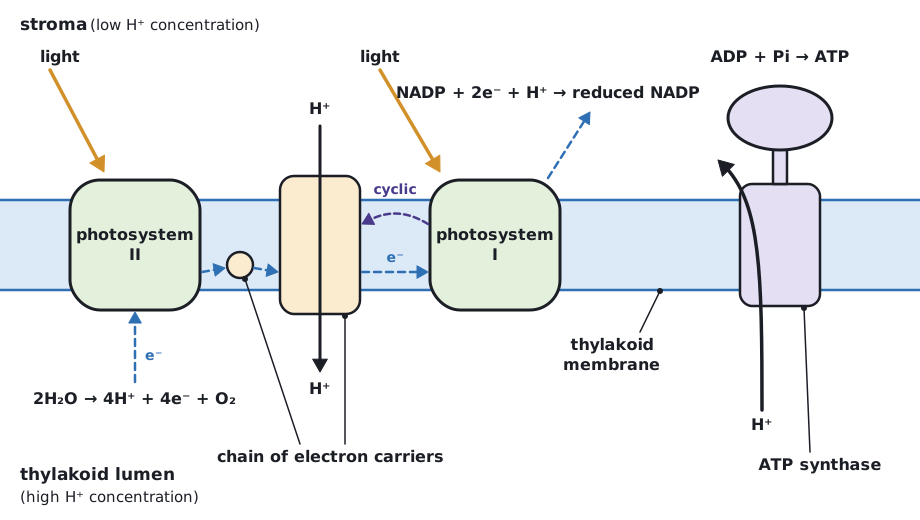
In the light-dependent reactions, excited electrons pass along a chain of carriers in the thylakoid membrane, pumping protons into the thylakoid lumen. Protons diffuse back through ATP synthase, making ATP by chemiosmosis. Electrons come from photosystem II in non-cyclic or photosystem I in cyclic photophosphorylation. Photosystem I passes electrons to NADP, which also takes a hydrogen ion from the stroma.
ATP production by chemiosmosis
- Excited electrons emitted by a photosystem pass along a chain of electron carriers in the thylakoid membrane.
- Energy released as the electrons flow is used to pump protons from the stroma into the thylakoid lumen.
- Protons (also released into the lumen by photolysis) build up a proton gradient: high concentration in the lumen, low in the stroma.
- Protons diffuse back into the stroma through ATP synthase, which uses the energy to phosphorylate ADP, releasing ATP into the stroma. This is chemiosmosis.
| Non-cyclic photophosphorylation | Cyclic photophosphorylation | |
|---|---|---|
| Source of electrons | Photosystem II | Photosystem I |
| Path of electrons | PSII → carrier chain → PSI → NADP | PSI → carrier chain → back to PSI |
| Products | ATP, reduced NADP and oxygen | ATP only |
| Photolysis of water | Yes | No |
Reduction of NADP by photosystem I
Photosystem I absorbs light and emits excited electrons. NADP is reduced by accepting two electrons that have come from photosystem I. It also accepts a hydrogen ion from the stroma, forming reduced NADP. Electrons lost from photosystem I are replaced by electrons arriving along the carrier chain from photosystem II.
Pair the terms consistently: write 'NADP and reduced NADP' or 'NADP⁺ and NADPH', never a mixture such as 'NADP and NADPH'.
Thylakoids as systems for the light-dependent reactions
| Process | Location |
|---|---|
| Light absorption by photosystems | Thylakoid membrane |
| Photolysis of water | Photosystem II, on the lumen side of the membrane; protons released into the lumen |
| Proton pumping | Electron carriers in the membrane, from stroma into lumen |
| ATP synthesis by chemiosmosis | ATP synthase in the membrane; ATP released into the stroma |
| Reduction of NADP | Stroma side of photosystem I |
The small volume of the thylakoid lumen means a steep proton gradient builds up quickly, and stacking thylakoids into grana gives a large membrane area for photosystems. ATP and reduced NADP are both released into the stroma, where the Calvin cycle uses them.
 (opens full size in a new tab)
Written and checked against the IB Biology HL specification · Updated October 2026