
Habitats and adaptations to the abiotic environmentSpec B4.1.1, B4.1.2
In short
A habitat is the place in which a community, species, population or organism lives. Organisms have adaptations to the abiotic conditions of their habitat: marram grass survives dry, shifting sand dunes with rolled leaves and deep rhizomes, and red mangrove survives salty, waterlogged mud with stilt roots, lenticels and salt-excluding roots.
A habitat is the place in which a community, species, population or organism lives. Describing a habitat can include its geographical location (for example the coast of north-west Europe), its physical location (the upper beach and foredunes) and the type of ecosystem (a sand dune system).
Every habitat has abiotic (non-living) conditions such as temperature, water availability, light, salinity, oxygen and soil type. An adaptation is a feature of structure, physiology or behaviour that increases the chance of survival and reproduction in those conditions.
A grass adapted to sand dunes: marram grass (Ammophila arenaria)
Sand dunes are dry because rain drains quickly through sand, windy, exposed to salt spray and constantly shifting. Marram grass is the main dune-building plant: it traps blown sand and thrives where sand keeps arriving.
- Leaves roll up in dry conditions, with the stomata on the inner surface. Humid air is trapped inside the roll, so less water is lost by transpiration.
- Stomata sit in pits and the inner surface has hairs, which trap still, moist air next to the stomata.
- Hinge cells lose turgor when water is short, which makes the leaf roll.
- A thick waxy cuticle on the outer surface reduces water loss.
- Long roots and vertical rhizomes reach water deep in the sand and anchor the plant. When sand buries the plant, the rhizomes grow upwards, so the grass keeps pace with the growing dune.
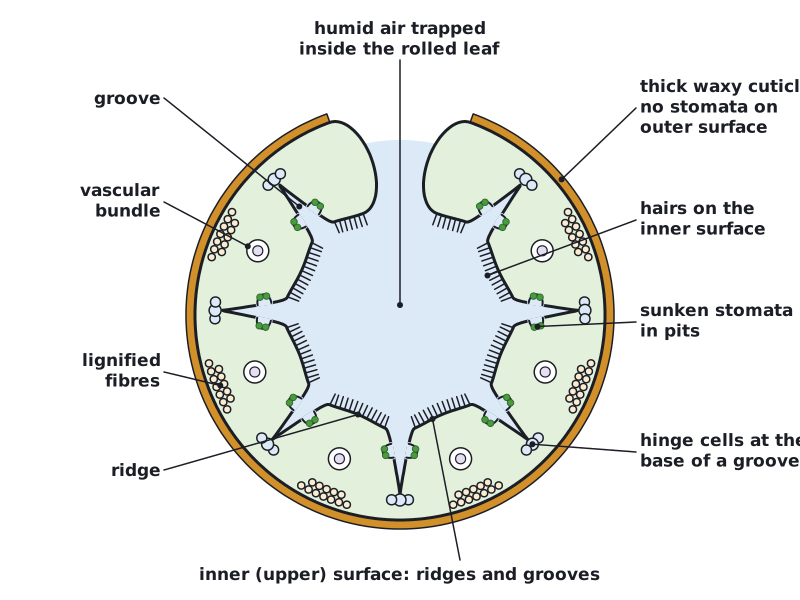 (opens full size in a new tab)
A tree adapted to mangrove swamps: red mangrove (Rhizophora mangle)
Mangrove swamps grow in the intertidal zone of tropical coasts. The mud is soft, waterlogged and low in oxygen, and it is flooded by salt water twice a day.
- Stilt (prop) roots arch out from the trunk and anchor the tree in soft mud.
- The aerial parts of the roots have lenticels that let oxygen diffuse in, because the waterlogged mud is anoxic.
- Roots exclude most salt as water is taken up, and salt that does build up is stored in older leaves that are then shed.
- Seeds germinate while still on the parent tree (vivipary). The seedling (propagule) drops and floats, then roots quickly in mud.
Always link each adaptation to the abiotic factor it deals with: "rolled leaves trap humid air, reducing transpiration in a dry habitat" earns the mark; "rolled leaves" alone does not.
Written and checked against the IB Biology HL specification · Updated October 2026