
Form and function in globular and fibrous proteinsSpec B1.2.12
In short
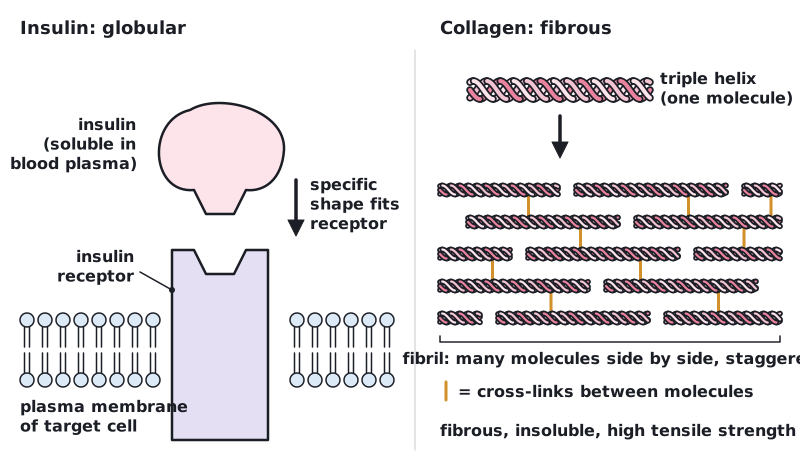
Globular proteins are rounded, compact and usually soluble, with a specific shape that suits roles such as hormones and enzymes; insulin is an example. Fibrous proteins are long, narrow and insoluble, with repetitive structure that gives strength; collagen is an example. In both, form is related to function: insulin binds a receptor, while collagen resists pulling forces.
| Feature | Globular | Fibrous |
|---|---|---|
| Shape | Rounded and compact, folded into a ball | Long and narrow, in strands |
| Solubility in water | Usually soluble: hydrophilic R-groups on the surface | Insoluble |
| Amino acid sequence | Irregular, giving a precise unique shape | Often repetitive |
| Typical functions | Hormones, enzymes, transport (e.g. haemoglobin), receptors | Structural support and strength |
| Example | Insulin | Collagen |
Insulin: a globular protein
- Insulin is a hormone secreted by beta cells of the pancreas when blood glucose is high.
- It is soluble, because hydrophilic R-groups are on its surface, so it is carried dissolved in blood plasma.
- Its precise globular shape fits a specific insulin receptor on the plasma membrane of target cells, such as muscle, adipose and liver cells. Binding triggers responses that lower blood glucose, for example uptake of glucose by muscle and adipose cells.
- Disulfide bonds between its two chains keep the shape stable.
Collagen: a fibrous protein
- Three polypeptides are wound into a triple helix, held together by hydrogen bonds between the chains.
- Every third amino acid is glycine, whose very small R-group lets the three chains pack tightly.
- Collagen molecules line up side by side and are cross-linked into fibrils, giving very high tensile strength with little stretch.
- It is found in skin, tendons, ligaments, bone and the walls of blood vessels, where it resists pulling forces.
 (opens full size in a new tab)
In form-and-function answers, pair every structural feature with what it allows: for example, triple helix with cross-links, so high tensile strength, so tendons do not stretch or tear.
Quick check
Which four groups are bonded to the alpha carbon of an amino acid?
Show answer
An amine group, a carboxyl group, a hydrogen atom and an R-group.
What is an essential amino acid?
Show answer
One that cannot be synthesised by the body and must be obtained from food.
What is denaturation?
Show answer
A usually permanent change in the three-dimensional structure of a protein, so it can no longer carry out its function.
HL only Which bonds stabilise alpha helices and beta-pleated sheets?
Show answer
Hydrogen bonds in regular positions between C=O and N–H groups of the backbone.
HL only Why is haemoglobin a conjugated protein?
Show answer
It contains non-polypeptide haem groups as well as its four polypeptide chains.
Written and checked against the IB Biology HL specification · Updated October 2026