
Early Earth and the first carbon compoundsSpec A2.1.1, A2.1.4
In short
On early Earth there was no free oxygen and therefore no ozone layer, so ultraviolet light reached the surface, and high concentrations of carbon dioxide and methane raised temperatures. Under these conditions carbon compounds may have formed spontaneously by chemical processes that no longer occur. The Miller–Urey experiment showed that amino acids can form this way from simple gases.
Earth formed about 4.5 billion years ago. Conditions on the early Earth were very different from today, and these differences explain how the first carbon compounds could have formed before any life existed (pre-biotic formation).
| Feature | Early Earth | Consequence |
|---|---|---|
| Free oxygen (O₂) | Little or none in the atmosphere | Newly formed carbon compounds were not broken down by oxidation |
| Ozone layer | Absent, because ozone (O₃) forms from oxygen | Ultraviolet light penetrated to the surface and supplied energy for reactions |
| Carbon dioxide and methane | Much higher concentrations than today | Strong greenhouse effect, so higher temperatures |
| Other energy sources | Frequent lightning, volcanic activity and meteorite impacts | Energy to break and form chemical bonds |
Under these conditions a variety of carbon compounds, such as amino acids, sugars and nucleotide bases, may have formed spontaneously by chemical processes that do not now occur. Today such compounds would not build up, because oxygen in the atmosphere oxidises them and living organisms quickly consume them.
Evidence: the Miller–Urey experiment
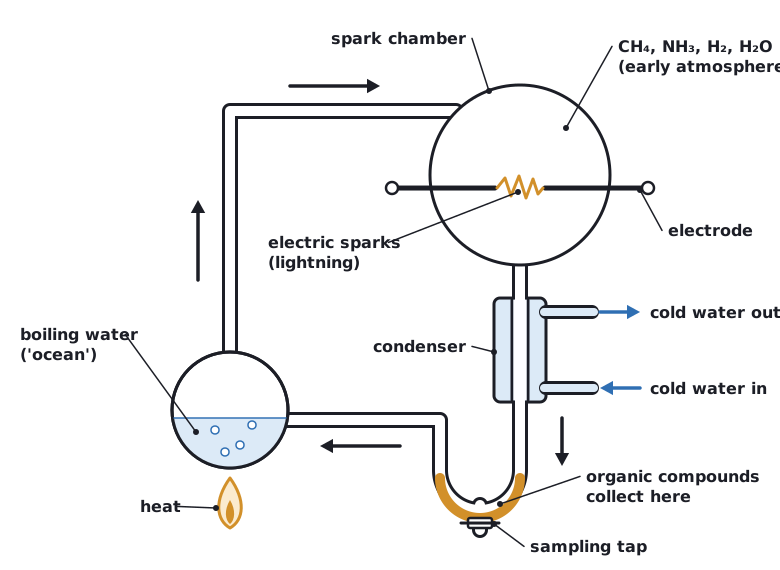
In 1952–53, Miller and Urey tested whether carbon compounds could form from inorganic molecules under conditions thought to resemble the early Earth.
- Water was boiled in a flask to produce water vapour, representing the ocean and evaporation.
- The vapour mixed with methane (CH₄), ammonia (NH₃) and hydrogen (H₂), representing an early atmosphere with no oxygen.
- Electrodes produced continuous sparks in the gas mixture, simulating lightning as an energy source.
- A condenser cooled the gases, so water and any dissolved products fell like rain into a trap and returned to the flask.
- After about a week the liquid had turned brown. Analysis showed several amino acids, including glycine and alanine, and other carbon compounds.
 (opens full size in a new tab)
Evaluating the experiment
| Aspect | Evaluation |
|---|---|
| Main finding | Strength: it showed that amino acids and other carbon compounds can form from inorganic molecules with no living organisms present. |
| Control and repeatability | Strength: the sealed, sterilised apparatus meant products could not come from contaminating organisms, and the experiment has been repeated many times. Reanalysis of stored samples in 2008 detected more than 20 amino acids. |
| Gas mixture | Limitation: the early atmosphere is now thought to have been less reducing, with more CO₂ and N₂. Repeats using such mixtures give much smaller yields of amino acids. |
| Scope | Limitation: it produced monomers only. It did not show how polymers, self-replicating molecules or cells formed. |
| Realism | Limitation: the exact conditions on early Earth are unknown and cannot be replicated, so the model may not match them. |
Amino acids have also been found in some meteorites, which supports the idea that carbon compounds can form by non-biological chemistry.
'Evaluate' needs strengths and limitations and a judgement: the experiment supports the idea that carbon compounds could form spontaneously, but says nothing about how cells arose.
Written and checked against the IB Biology HL specification · Updated October 2026