
The kidney: excretion, ultrafiltration and reabsorptionSpec D3.3.7, D3.3.8
In short
The kidney carries out both excretion, the removal of metabolic wastes such as urea, and osmoregulation, the regulation of osmotic concentration, measured in osmol L⁻¹. Ultrafiltration in the glomerulus and Bowman's capsule removes small solutes and water from blood plasma; the proximal convoluted tubule then reabsorbs useful substances, leaving toxins and other unwanted solutes to be excreted in urine.
- Excretion
- Removal from the body of the waste products of metabolism, such as urea, and of toxins and other unwanted solutes.
- Osmoregulation
- Regulation of the osmotic concentration of body fluids (the amount of water relative to solutes), in osmoles per litre (osmol L⁻¹).
The kidneys do both. Each contains about a million nephrons, the tubules that make urine.
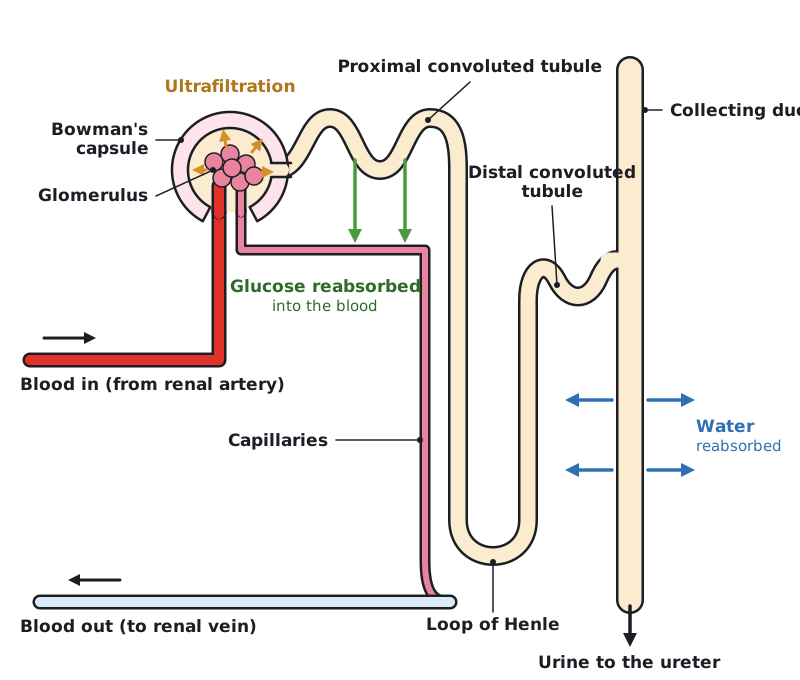 (opens full size in a new tab)
Ultrafiltration: glomerulus and Bowman's capsule
- The glomerulus is a knot of capillaries. Its incoming arteriole is wider than the outgoing one, so blood pressure inside is high.
- Pressure forces plasma out through gaps in the capillary wall, a fine filter (the basement membrane) and slits between the cells lining Bowman's capsule.
- The filtrate contains water, glucose, amino acids, mineral ions, urea and other small solutes. Blood cells and most plasma proteins are too large and stay in the blood.
Selective reabsorption: proximal convoluted tubule
- In the proximal convoluted tubule all of the glucose and amino acids are reabsorbed into the blood, by active transport and co-transport with sodium ions.
- Most of the mineral ions and most of the water (by osmosis) are also reabsorbed here.
- The tubule wall cells have microvilli for a large surface area and many mitochondria to supply ATP for active transport.
- Toxins, urea and other unwanted solutes are not reabsorbed (or only partly), so they stay in the filtrate and are excreted in urine.
Common mistake:
Filtration is not selective: it is based on size. The selection happens afterwards, when useful substances are reabsorbed.
Written and checked against the IB Biology HL specification · Updated October 2026