
Making other carbon compounds and interdependence of the reactionsSpec C1.3.18, C1.3.19
In short
All the carbon in compounds in photosynthesising organisms is fixed in the Calvin cycle. Triose phosphate and other cycle intermediates, with mineral nutrients such as nitrate and phosphate, are used to make carbohydrates, amino acids and other carbon compounds. The light-dependent and light-independent reactions are interdependent: without light, ATP and reduced NADP run out; without CO₂, NADP is not regenerated.
Synthesis of other carbon compounds
All of the carbon in compounds in photosynthesising organisms is fixed in the Calvin cycle. Glucose is only one product. Other carbon compounds are made by metabolic pathways that can be traced back to an intermediate in the cycle, usually triose phosphate. You do not need the details of these pathways.
| Product | Made from | Mineral nutrients also needed |
|---|---|---|
| Glucose, sucrose, starch, cellulose | Triose phosphate | None |
| Fatty acids and glycerol (lipids) | Triose phosphate and other intermediates | None (phosphate for phospholipids) |
| Amino acids (proteins) | Calvin cycle intermediates | Nitrogen (nitrate or ammonium); sulfur for some |
| Nucleotides (DNA, RNA, ATP) | Calvin cycle intermediates | Nitrogen and phosphate |
Interdependence of the light-dependent and light-independent reactions
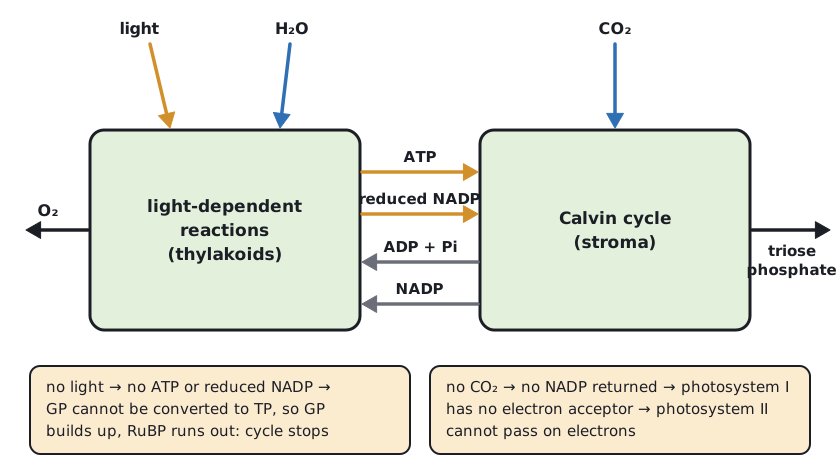
The light-dependent reactions supply ATP and reduced NADP to the Calvin cycle; the Calvin cycle returns ADP, phosphate and NADP. Neither can continue for long without the other.
- Lack of light stops the light-dependent reactions, so no ATP or reduced NADP is made. GP cannot be converted to TP, so GP accumulates and RuBP is not regenerated. The Calvin cycle stops.
- Lack of CO₂ stops carbon fixation, so ATP and reduced NADP are not used. NADP is not regenerated, so photosystem I has no electron acceptor and the electron carriers stay reduced. Electrons from photosystem II cannot be passed on, so photosystem II stops functioning, and photolysis and oxygen production stop.
 (opens full size in a new tab)
For a change in conditions, predict what builds up and what runs out. Darkness: GP rises and RuBP falls. Low CO₂: RuBP rises and GP falls.
Quick check
Write the word equation for photosynthesis.
Show answer
carbon dioxide + water → glucose + oxygen
Where does the oxygen released by photosynthesis come from?
Show answer
The splitting of water.
How is an Rf value calculated?
Show answer
Distance moved by the pigment ÷ distance moved by the solvent front.
What is the difference between an absorption spectrum and an action spectrum?
Show answer
An absorption spectrum shows light absorbed by a pigment at each wavelength; an action spectrum shows the rate of photosynthesis at each wavelength.
HL only What are the substrates and product of the reaction catalysed by Rubisco?
Show answer
Substrates: RuBP and CO₂. Product: glycerate 3-phosphate (GP).
Written and checked against the IB Biology HL specification · Updated October 2026