
Transcription and gene expressionSpec D1.2.1, D1.2.2, D1.2.3, D1.2.4
In short
Transcription is the synthesis of RNA using a DNA template. RNA polymerase separates the DNA strands and links RNA nucleotides that pair with the template strand, with uracil pairing with adenine. The DNA is not changed, so it can be transcribed throughout a cell's life, and transcription is a key stage at which genes are switched on or off.
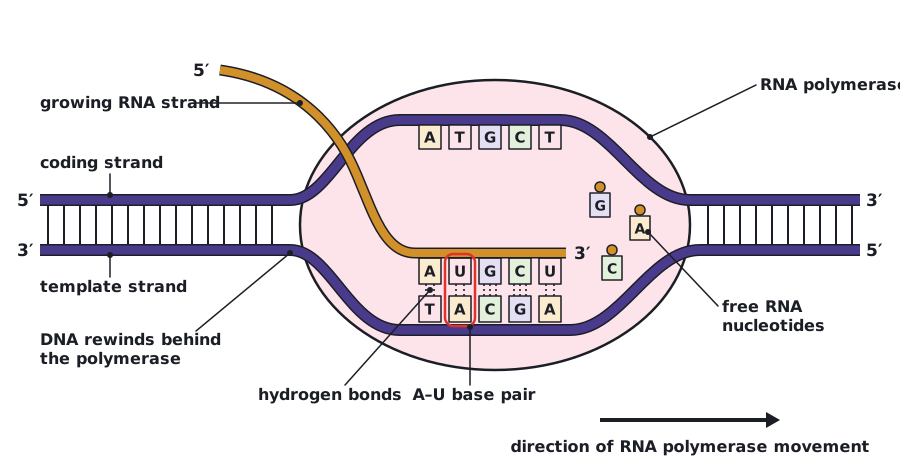
Transcription is the synthesis of RNA using a DNA template. Only one of the two DNA strands, the template strand, is transcribed. The other strand is the coding strand: the RNA has the same base sequence as the coding strand, except that uracil replaces thymine.
Roles of RNA polymerase
- RNA polymerase binds to DNA at the start of a gene.
- It unwinds the double helix and separates the two strands by breaking hydrogen bonds between bases, over a short stretch of DNA.
- Free RNA nucleotides pair with exposed bases on the template strand by complementary base pairing.
- RNA polymerase links the RNA nucleotides with covalent bonds to form a single strand of RNA.
- Behind the polymerase, the RNA separates from the template and the DNA strands re-form their hydrogen bonds and rewind.
Hydrogen bonding and complementary base pairing
Each RNA nucleotide is held in place by hydrogen bonds to the complementary base on the template strand. The pairs are: adenine (A) on the DNA template with uracil (U) on the RNA, thymine (T) on the template with adenine (A), cytosine (C) with guanine (G) and guanine (G) with cytosine (C). The hydrogen bonds are weak, so the RNA can separate from the template once its nucleotides are linked.
Stability of DNA templates
A single DNA strand can be used as a template for transcribing a base sequence without the DNA base sequence changing: only hydrogen bonds are broken and then re-formed. In somatic cells that do not divide, such as many neurones, the same DNA must be transcribed again and again, so its sequences must be conserved throughout the life of the cell.
Transcription and gene expression
Not all genes in a cell are expressed at any given time. Transcription is the first stage of gene expression, so it is a key stage at which the expression of a gene can be switched on or off. A gene that is not transcribed produces no mRNA and so no polypeptide.
 (opens full size in a new tab)
Linking question: what biological processes depend on hydrogen bonding? Replication, transcription and codon–anticodon pairing all rely on hydrogen bonds being strong enough to hold bases in place but weak enough to break easily.
Written and checked against the IB Biology HL specification · Updated October 2026