
Amino acids and peptide bonds

Molecules (Form and function) · Proteins · note 1 of 8

Amino acids and peptide bondsSpec B1.2.1, B1.2.2

In short

An amino acid has a central alpha carbon atom bonded to an amine group, a carboxyl group, a hydrogen atom and a variable R-group. In a condensation reaction the carboxyl group of one amino acid reacts with the amine group of another, forming a peptide bond and releasing water. Repeating this produces a polypeptide.

Proteins are made of one or more polypeptides, which are chains of amino acids. Every amino acid has the same basic structure, built around a central carbon called the alpha carbon.

  • an amine group (–NH₂)
  • a carboxyl group (–COOH)
  • a hydrogen atom (–H)
  • an R-group, which differs between the 20 amino acids
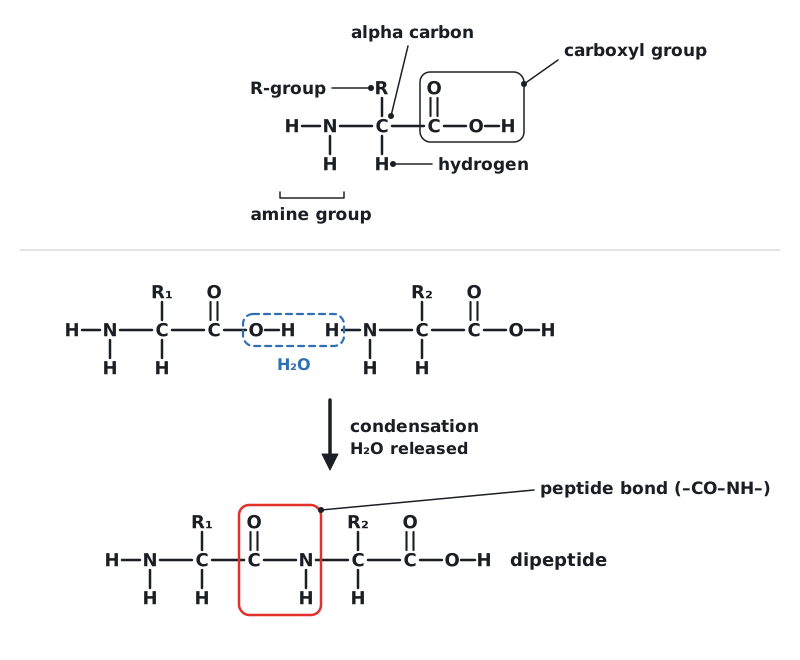
Top: a generalised amino acid, with the alpha carbon bonded to an amine group (–NH₂), a carboxyl group (–COOH), a hydrogen atom and an R-group. Below: two amino acids with the –OH of the first carboxyl group and an H of the second amine group boxed as water; a condensation arrow leads to a dipeptide with the –CO–NH– peptide bond boxed and R₁ and R₂ labelled. (opens full size in a new tab)
Every amino acid has an amine group, a carboxyl group, H and an R-group on the alpha carbon; condensation joins two by a peptide bond.
Exam tip:

When drawing an amino acid, show every bond to the alpha carbon and write the groups in full: H₂N–, –COOH, –H and R. Marks are lost for a missing hydrogen on the alpha carbon.

Forming dipeptides and polypeptides

The carboxyl group of one amino acid reacts with the amine group of the next in a condensation reaction. An –OH and an –H are removed as water, and a peptide bond (–CO–NH–) forms between the carbon and the nitrogen.

amino acid + amino acid → dipeptide + water

Further condensation reactions add amino acids one at a time to form a polypeptide. In cells this happens on ribosomes during translation. A polypeptide still has a free amine group at one end and a free carboxyl group at the other.

Practical skill:

Build two amino acids with molecular models, remove –OH and –H to make water, then join the C and N. Drawing the dipeptide afterwards helps you place the peptide bond correctly.

Written and checked against the IB Biology HL specification · Updated October 2026

Frequently asked questions

What is the difference between essential and non-essential amino acids?

Essential amino acids cannot be synthesised by the body, so they must be obtained from food. Non-essential amino acids can be made in the body from other amino acids. Some plant proteins are low in certain essential amino acids, so vegans eat a variety of plant protein sources to get all of them.

Why do proteins denature at high temperatures?

Proteins denature at high temperatures because heat makes the molecule vibrate more until hydrogen bonds and other weak interactions holding its three-dimensional shape break. The protein unfolds and loses its function. Peptide bonds are not broken, so the amino acid sequence is unchanged, but the change in shape is usually permanent.

How does pH affect protein structure?

A change in pH changes the charges on R-groups, because amine and carboxyl groups gain or lose hydrogen ions. Ionic bonds between oppositely charged R-groups break, and hydrogen bonding changes, so the protein's three-dimensional shape alters. Outside its stable pH range a protein denatures and stops functioning, for example an enzyme losing its active site shape.

All 5 questions on Proteins