
Fatty acids, energy storage and insulationSpec B1.1.10, B1.1.11
In short
A saturated fatty acid has no C=C double bonds, a monounsaturated fatty acid has one and a polyunsaturated fatty acid has two or more. Double bonds bend the chain, so unsaturated fatty acids pack less tightly and have lower melting points. Triglycerides in adipose tissue store energy long-term and insulate endotherms, especially those in cold habitats.
Fatty acids have a carboxyl group at one end of a hydrocarbon chain. They differ in chain length and in the number of double bonds between carbon atoms (C=C).
| Type | C=C double bonds | Chain shape | Melting point |
|---|---|---|---|
| Saturated | None: every carbon holds as many H atoms as possible | Straight | Highest |
| Monounsaturated | One | One bend at the double bond | Lower |
| Polyunsaturated | Two or more | Several bends | Lowest |
Straight saturated chains pack closely, so the attractions between them are strong and more energy is needed to melt them. A double bond (in the usual cis form) puts a bend in the chain, so chains cannot pack closely and the melting point is lower.
This links to where fats and oils are stored. Plants store oils rich in unsaturated fatty acids, for example in seeds. Plants are not endotherms, so their tissues are often cool, and low-melting oils stay liquid there. Endotherms such as mammals and birds store fats with a higher proportion of saturated fatty acids than plant oils. These fats are solid at room temperature, but the endotherm's warm body keeps them soft enough to store and mobilise.
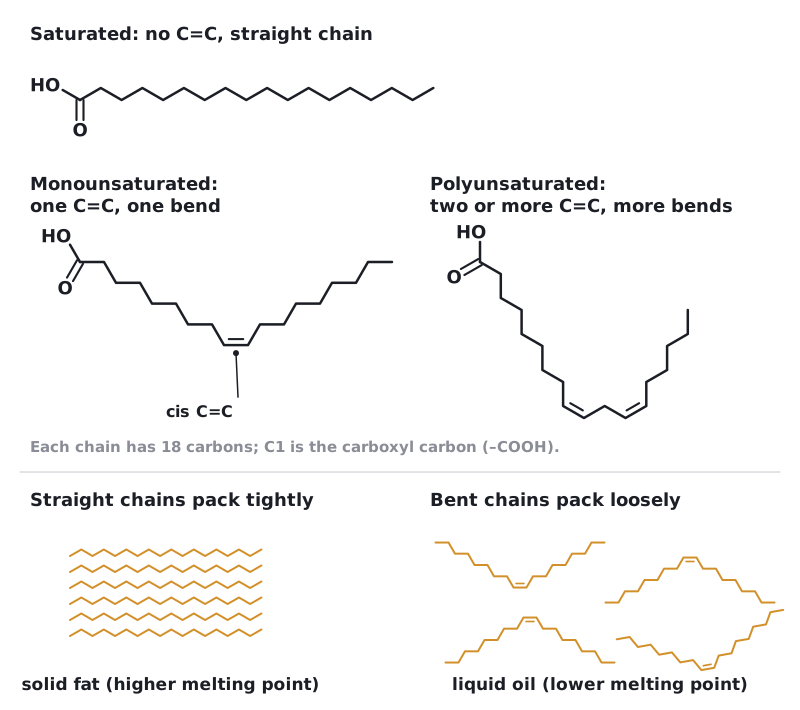 (opens full size in a new tab)
Triglycerides in adipose tissue
Adipose tissue is made of cells filled with triglyceride droplets. It lies under the skin and around organs. Triglycerides are suited to long-term energy storage because:
- They release about twice as much energy per gram as carbohydrates when oxidised (about 37 kJ g⁻¹ compared with about 17 kJ g⁻¹).
- They are insoluble, so they have no osmotic effect and stay in the cells.
- They are stored without water, whereas glycogen is stored bound to water, so the same energy store adds much less mass.
- They are chemically stable, so they can be kept for long periods.
Fat is a poor conductor of heat, so a layer of adipose tissue under the skin acts as thermal insulation. This matters for endotherms, which keep a body temperature above that of their surroundings. The colder the habitat, the more important it is: seals and whales in cold seas have a thick layer of blubber, and animals that hibernate build up adipose tissue as a store for winter.
Guiding question: carbohydrates versus lipids for storage. Glycogen and starch are for short-term storage because glucose is released quickly; triglycerides are for long-term storage because they hold more energy per gram.
Written and checked against the IB Biology HL specification · Updated October 2026