Adaptations of mitochondria and chloroplasts

Cells (Form and function) · Organelles and compartmentalization · note 2 of 4

Spec B2.2.4, B2.2.5
HL only (what this means)HL only: additional Higher Level content, only for HL students. SL students can skip it. What the labels mean
Download all Organelles and compartmentalization notes (PDF)Download all notes (PDF)8 pages

Adaptations of mitochondria and chloroplastsSpec B2.2.4, B2.2.5

In short

The mitochondrion is adapted for aerobic respiration by a double membrane with a small intermembrane space, an inner membrane folded into cristae for a large surface area, and a matrix holding Krebs cycle enzymes and substrates. The chloroplast has a large area of thylakoid membranes with photosystems, small volumes inside thylakoids, and Calvin cycle enzymes in the stroma.

Adaptations of the mitochondrion for production of ATP by aerobic cell respiration
FeatureAdaptation
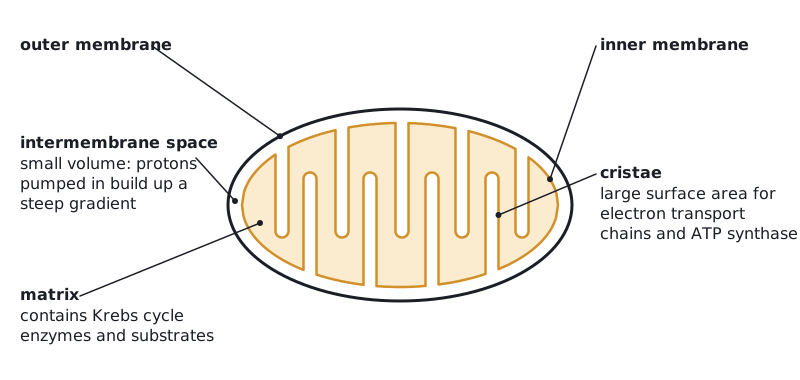
Double membraneThe outer membrane separates the mitochondrion from the cytoplasm; the inner membrane holds the electron transport chain and ATP synthase.
Small volume of intermembrane spaceProtons pumped into it by the electron transport chain quickly build up to a high concentration, giving a steep gradient for making ATP by chemiosmosis.
CristaeFolds of the inner membrane give a large surface area for many electron transport chains and ATP synthase molecules.
MatrixCompartmentalizes the enzymes and substrates of the Krebs cycle, keeping them together at high concentration.
Adaptations of the chloroplast for photosynthesis
FeatureAdaptation
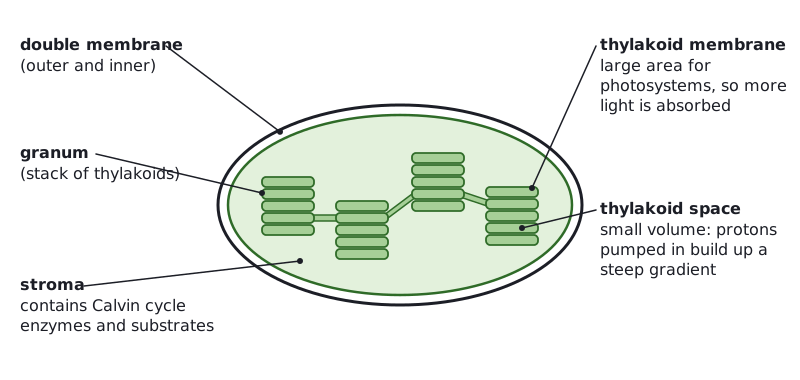
Thylakoid membranesStacked into grana, giving a large surface area for photosystems, so more light can be absorbed.
Small volume of fluid inside thylakoidsProtons pumped into the thylakoid space quickly reach a high concentration, giving a steep gradient for making ATP.
StromaCompartmentalizes the enzymes and substrates of the Calvin cycle, close to the ATP and NADPH made by the thylakoids.
Annotated mitochondrion labelled outer membrane, inner membrane, cristae, intermembrane space and matrix, with notes on the large surface area of the cristae, the small intermembrane space giving a steep proton gradient and the Krebs cycle enzymes in the matrix. (opens full size in a new tab)
Mitochondrion: cristae give a large area for electron transport chains and ATP synthase.
Annotated chloroplast labelled double membrane, granum (stack of thylakoids), thylakoid membrane, thylakoid space and stroma, with notes on the large area of thylakoid membrane for photosystems, the small thylakoid space giving a steep proton gradient and the Calvin cycle enzymes in the stroma. (opens full size in a new tab)
Chloroplast: stacked thylakoids give a large area for photosystems; the stroma holds the Calvin cycle enzymes.
Exam tip:

For an 'explain the adaptation' question, give the feature and then its effect: for example, a small intermembrane space, so a high proton concentration builds up quickly.

Written and checked against the IB Biology HL specification · Updated October 2026

Frequently asked questions

Is a ribosome an organelle?

Yes. In IB Biology an organelle is a discrete subunit of a cell adapted to perform a specific function, so ribosomes count even though they have no membrane. Nuclei, vesicles and the plasma membrane are organelles too, but the cell wall, cytoskeleton and cytoplasm are not considered organelles.

What are the advantages of compartmentalization in cells?

Compartments let a cell concentrate enzymes and their substrates in a small volume, so reactions run faster, and keep incompatible processes apart. For example, lysosomes hold hydrolytic enzymes that would digest the cell if free, and the nuclear membrane lets mRNA be modified before it meets ribosomes.

How does cell fractionation separate organelles?

Cell fractionation breaks cells open in a cold, isotonic, buffered solution and then spins the homogenate in a centrifuge at increasing speeds. Large, dense organelles such as nuclei form a pellet first; mitochondria pellet at higher speeds, and the smallest parts, such as ribosomes, need an ultracentrifuge. Each fraction can then be studied.

All 5 questions on Organelles and compartmentalization