
Feedback control of heart rate and ventilation rateSpec C3.1.14, C3.1.15
In short
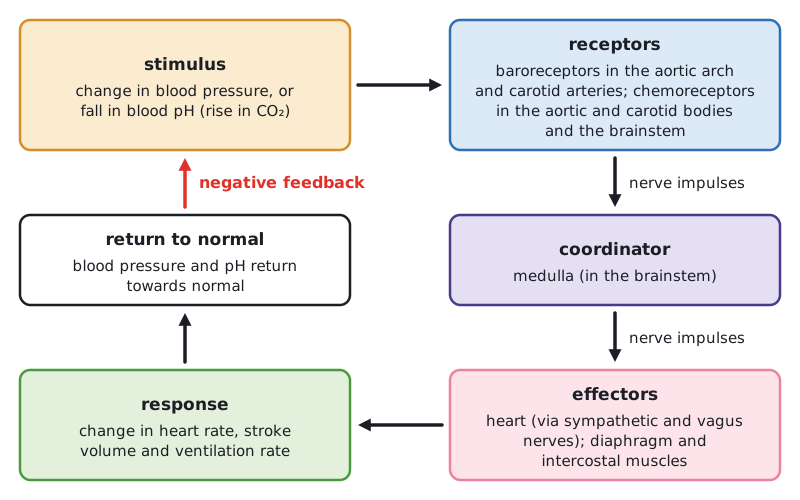
Heart rate and ventilation rate are controlled by negative feedback. Baroreceptors monitor blood pressure and chemoreceptors monitor blood pH and the concentrations of oxygen and carbon dioxide. The medulla coordinates the response, sending nerve impulses to the heart to change heart rate and stroke volume, and to the diaphragm and intercostal muscles to change ventilation rate.
Receptors and their location
| Receptor | What it monitors | Location |
|---|---|---|
| Baroreceptors | Blood pressure (stretch of the artery wall) | Walls of the aorta (aortic arch) and the carotid arteries (carotid sinus) |
| Peripheral chemoreceptors | Blood pH and concentrations of oxygen and carbon dioxide | Aortic bodies and carotid bodies |
| Central chemoreceptors | pH (and so carbon dioxide concentration) | Brainstem (medulla) |
Control of heart rate
The medulla (in the brainstem) coordinates the response. It sends nerve impulses to the heart through two nerves: impulses along a sympathetic nerve increase heart rate and the force of contraction (stroke volume); impulses along the vagus nerve (parasympathetic) decrease heart rate. Both act on the pacemaker (sinoatrial node); sympathetic impulses also act on the ventricle walls to increase the force of contraction.
- During exercise, muscles respire faster, so blood carbon dioxide rises and pH falls; blood oxygen may fall.
- Chemoreceptors detect the change and send impulses to the medulla.
- The medulla sends more impulses along the sympathetic nerve to the heart: heart rate and stroke volume increase.
- More blood flows to the lungs and muscles, removing carbon dioxide and supplying oxygen, so pH returns towards normal.
- If blood pressure rises too high, baroreceptors are stretched more and send more impulses to the medulla, which sends impulses along the vagus nerve to slow the heart: negative feedback.
Control of ventilation rate
Blood pH changes mainly because of carbon dioxide. Carbon dioxide reacts with water to form carbonic acid, which dissociates into hydrogen ions and hydrogencarbonate ions: CO₂ + H₂O → H₂CO₃ → H⁺ + HCO₃⁻. So when respiration increases, more CO₂ enters the blood and blood pH falls. Lactic acid from anaerobic respiration in muscles can lower pH further.
Chemoreceptors in the brainstem detect the fall in pH and the medulla sends more nerve impulses to the diaphragm and intercostal muscles. These contract more often and more strongly, so the ventilation rate and depth increase. More CO₂ is exhaled, blood pH rises back towards normal, and the stimulus is reduced: negative feedback.
 (opens full size in a new tab)
Ventilation rate is mainly driven by a rise in CO₂ (fall in pH), not by a fall in O₂. Write 'chemoreceptors detect a fall in blood pH' rather than 'the body detects a lack of oxygen'.
Exercise data often ask for a percentage change: (new value − original value) ÷ original value × 100. A heart rate rising from 70 to 140 beats per minute is a 100% increase.
Written and checked against the IB Biology HL specification · Updated October 2026