
Physical properties of water and aquatic animalsSpec A1.1.6
In short
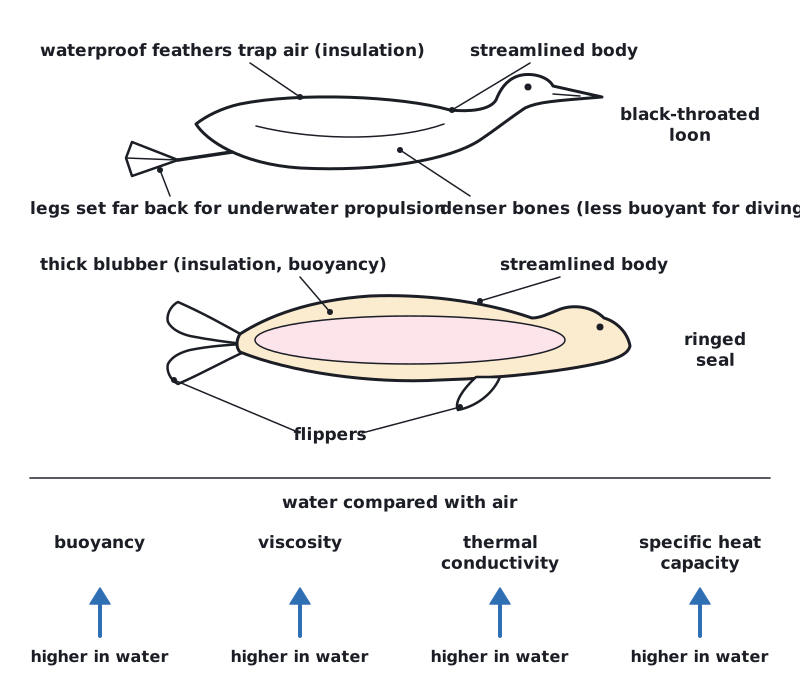
Water differs from air in buoyancy, viscosity, thermal conductivity and specific heat capacity. Water is far denser and more viscous, so it supports bodies but resists movement. It conducts heat much faster, so endotherms lose heat quickly, and its high specific heat capacity keeps aquatic temperatures stable. The black-throated loon and ringed seal show adaptations to water and air.
| Property | Water | Air | Consequence for animals in water |
|---|---|---|---|
| Buoyancy (density) | about 1000 kg m⁻³ | about 1.2 kg m⁻³ | Water gives a large upward force, so bodies are supported and less energy is used to stay up; animals in air must support their own weight |
| Viscosity | about 1.0 mPa s | about 0.018 mPa s | Water is about 55 times more viscous, so there is more drag when moving through it and streamlined body shapes are an advantage |
| Thermal conductivity | about 0.6 W m⁻¹ K⁻¹ | about 0.026 W m⁻¹ K⁻¹ | Water conducts heat about 23 times faster than air, so a warm body loses heat much faster in water and endotherms need insulation |
| Specific heat capacity | 4.18 J g⁻¹ °C⁻¹ | about 1.0 J g⁻¹ °C⁻¹ | Water temperature changes slowly, giving a thermally stable habitat |
The high specific heat capacity of water is due to hydrogen bonding: energy is needed to break hydrogen bonds before molecules can move faster, so a lot of energy is needed to raise the temperature of water. Lakes and seas therefore change temperature much more slowly than the air above them.
Black-throated loon (Gavia arctica)
- A diving bird that lives on water but must also fly through air and nest on land.
- Streamlined body and legs set far back on the body reduce drag and give strong propulsion underwater, against the viscosity of water; the same leg position makes it clumsy on land.
- Its bones are less air-filled than those of most birds, so it is less buoyant and can dive more easily; it needs fast wingbeats to stay up in air, which gives little buoyancy.
- Dense, waterproof feathers trap a layer of air, which insulates the body because air has a low thermal conductivity. Before a dive it can squeeze air out of its feathers and air sacs to reduce buoyancy.
Ringed seal (Pusa hispida)
- A marine mammal of Arctic seas that swims under sea ice but breathes air and rests on the ice.
- A thick layer of blubber insulates it against heat loss to cold water, which has a high thermal conductivity; blubber also adds buoyancy.
- Streamlined shape and flippers reduce drag in viscous water.
- In water its weight is supported by buoyancy; on ice it must support its own weight and moves slowly and awkwardly.
 (opens full size in a new tab)
In an exam either the common name or the scientific name of an organism is acceptable. Link each adaptation to a named property of water, for example blubber to thermal conductivity.
Written and checked against the IB Biology HL specification · Updated October 2026