
Segregation, independent assortment and dihybrid crossesSpec D3.2.16, D3.2.17
In short
Segregation is the separation of the two alleles of a gene into different gametes during meiosis. Independent assortment means the alleles of unlinked genes on different chromosomes go into gametes in all combinations equally, because bivalents orient randomly at metaphase I. Crossing two double heterozygotes gives a 9:3:3:1 ratio; a test cross gives 1:1:1:1.
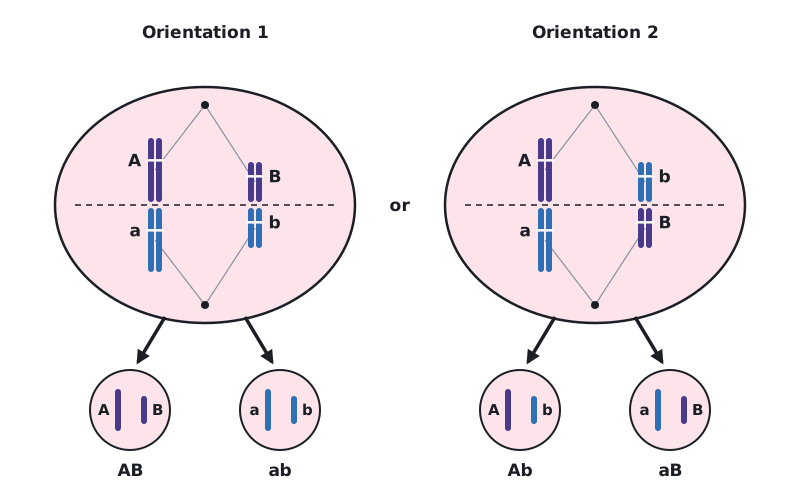
- Segregation: homologous chromosomes separate in meiosis I, so the two alleles of each gene go to different gametes. Each gamete gets one allele of each gene.
- Independent assortment: each bivalent lines up at metaphase I with a random orientation, independently of other bivalents. For genes on different chromosomes (unlinked genes), an AaBb individual makes four gamete types, AB, Ab, aB and ab, in equal numbers.
 (opens full size in a new tab)
Deriving the 9:3:3:1 ratio
In peas, round seed (R) is dominant to wrinkled (r) and yellow (Y) is dominant to green (y). Two RrYy plants are crossed. Deduce the phenotypic ratio.
- Each parent makes gametes RY, Ry, rY, ry in equal proportions.
- A 4 × 4 Punnett grid gives 16 equally likely combinations.
- Round yellow (R_Y_): 9. Round green (R_yy): 3. Wrinkled yellow (rrY_): 3. Wrinkled green (rryy): 1.
Answer: 9 round yellow : 3 round green : 3 wrinkled yellow : 1 wrinkled green.
Deriving the 1:1:1:1 ratio
An RrYy plant is crossed with an rryy plant (a test cross). Deduce the offspring ratio.
- RrYy gametes: RY, Ry, rY, ry, in equal numbers. rryy gametes: all ry.
- Offspring: RrYy, Rryy, rrYy, rryy.
Answer: 1 round yellow : 1 round green : 1 wrinkled yellow : 1 wrinkled green.
Nature of science: these ratios rest on Mendel's second law, which only applies if genes are on different chromosomes or far enough apart for recombination to reach 50%. Biological 'laws' have exceptions.
Written and checked against the IB Biology HL specification · Updated October 2026