
Phospholipid bilayers and steroidsSpec B1.1.12, B1.1.13
In short
Phospholipids are amphipathic: they have a hydrophilic phosphate head and two hydrophobic hydrocarbon tails. In water they form a bilayer, with heads facing the water on both sides and tails facing each other in the middle. Steroids such as oestradiol and testosterone are non-polar, so they can pass through the hydrophobic core of the bilayer.
- Amphipathic
- Having both a hydrophilic region and a hydrophobic region in the same molecule.
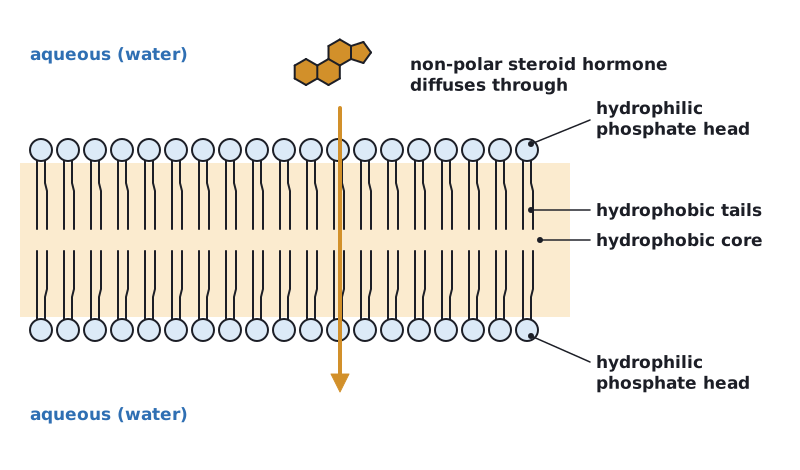
A phospholipid is amphipathic. The phosphate group carries a charge, so the head is hydrophilic and attracted to water. The two fatty acid tails are hydrophobic.
In water, phospholipids arrange themselves so that the heads face the water and the tails avoid it. The result is a phospholipid bilayer: two layers of molecules, heads outwards on each surface and tails pointing inwards to form a hydrophobic core. This forms spontaneously, because it is the most stable arrangement. The bilayer is the basis of every cell membrane.
 (opens full size in a new tab)
Steroids
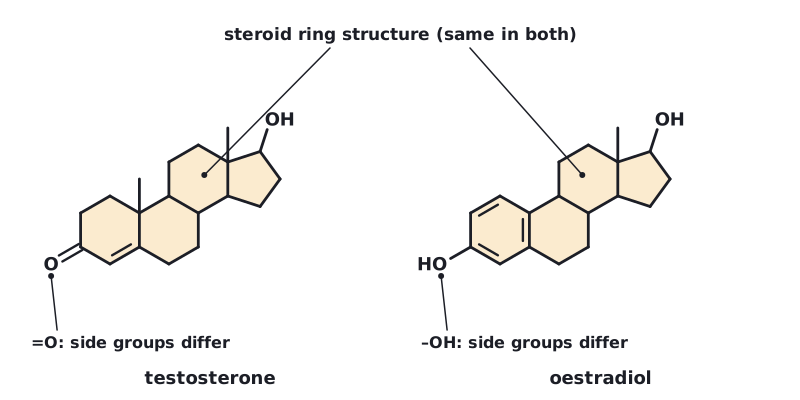
Steroids are lipids with a characteristic skeleton of four fused rings of carbon atoms: three rings of six carbons and one ring of five. You can identify a steroid from a molecular diagram by this ring pattern; the side groups attached to it differ between steroids.
Steroids are largely non-polar, so they can pass through the hydrophobic core of the bilayer by simple diffusion. The sex hormones oestradiol and testosterone are steroids. They pass through the plasma membrane of target cells and bind to receptor proteins inside the cell.
 (opens full size in a new tab)
Ions and polar molecules cannot easily cross the hydrophobic core, but non-polar steroids can. Use the word hydrophobic core, not just membrane, in explanations.
Quick check
How many covalent bonds can a carbon atom form?
Show answer
Up to four, which can be single bonds or a combination of single and double bonds.
What is released when two monosaccharides are joined by condensation?
Show answer
A molecule of water.
Which monomer makes up cellulose?
Show answer
Beta-glucose, linked in alternating orientation.
What is meant by amphipathic?
Show answer
A molecule with both a hydrophilic region and a hydrophobic region, such as a phospholipid.
Name two steroid hormones that pass through the phospholipid bilayer.
Show answer
Oestradiol and testosterone.
Written and checked against the IB Biology HL specification · Updated October 2026