
Living and non-living, and the challenge of the first cellsSpec A2.1.2, A2.1.3
In short
Cells are the smallest units of self-sustaining life: one cell can carry out all the functions of life. Viruses are considered non-living because they have no metabolism of their own and can only reproduce inside a host cell. Today cells only arise by division of pre-existing cells, so explaining how the first cells formed spontaneously is a major challenge.
Cells are the smallest units of self-sustaining life. A single cell can take in energy and materials, carry out metabolism, keep its internal conditions stable and reproduce. Nothing smaller than a cell, such as an organelle or a molecule, can do all of these on its own.
Living things carry out all the functions of life: metabolism, nutrition, growth, response to stimuli, homeostasis, excretion, movement and reproduction. Non-living things may show one or two of these (a crystal grows, a flame uses oxygen) but not all of them together, and they have no genetic material that is inherited and evolves.
Why viruses are considered non-living
- They are not cells: they have no cytoplasm and no plasma membrane of their own.
- They have no metabolism of their own: they produce no ATP and have few or no enzymes.
- They cannot reproduce independently: they use the host cell's ribosomes, enzymes, ATP, nucleotides and amino acids to make copies of themselves.
- They do not grow, excrete or maintain homeostasis, and outside a host cell they are inert particles.
Viruses do have genetic material and evolve by natural selection, which is why their status is sometimes debated.
The challenge of explaining the origin of cells
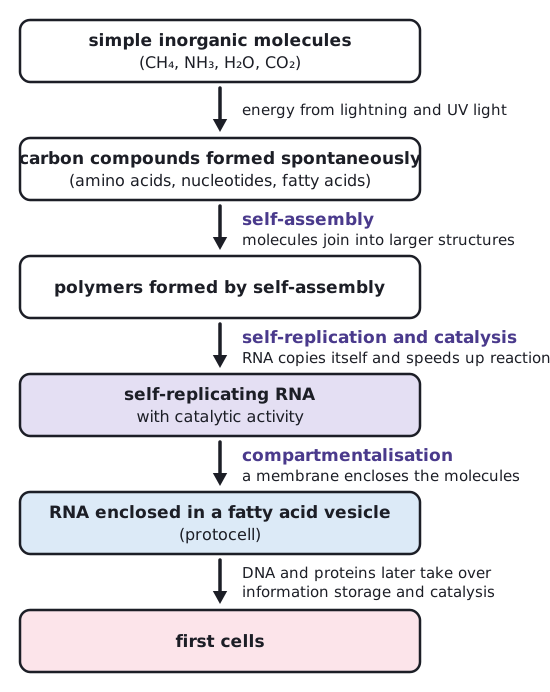
Cells are highly complex structures that can currently only be produced by division of pre-existing cells. For the first cells to arise from non-living matter, several requirements had to be met.
| Requirement | Why it was needed |
|---|---|
| Catalysis | Reactions had to be speeded up so molecules could be made fast enough; early catalysts may have been mineral surfaces or RNA |
| Self-replication of molecules | A molecule had to be copied so that information could be passed on and inherited |
| Self-assembly | Molecules had to join spontaneously into larger structures, such as polymers and membranes |
| Compartmentalisation | A membrane boundary had to enclose the molecules so internal chemistry could differ from the surroundings |
 (opens full size in a new tab)
Nature of science: hypotheses must be testable. The exact conditions on pre-biotic Earth cannot be replicated and the first protocells did not fossilise, so hypotheses about the origin of cells are difficult to test.
Written and checked against the IB Biology HL specification · Updated October 2026