
IB Diploma Biology HL, topic A2
Cells (Unity and diversity)
Cells are the basic structural unit of all living organisms. This group covers the structure of prokaryote and eukaryote cells and the microscopy used to study them, how the first cells may have arisen on the early Earth (HL), and the structure, life cycles and evolution of viruses (HL).
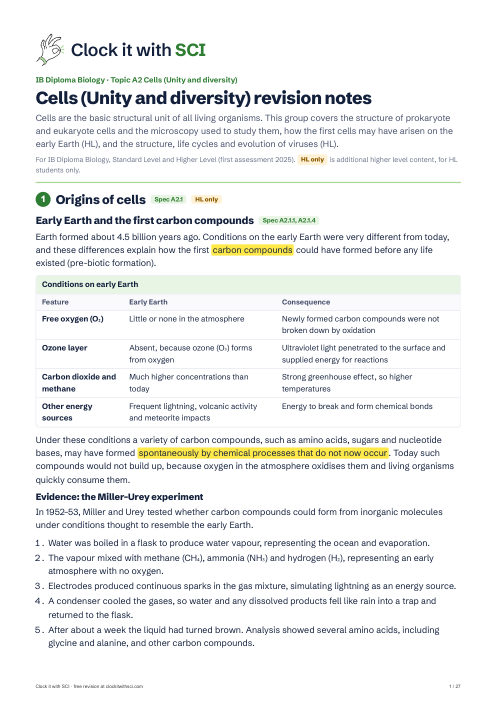 Revision notes
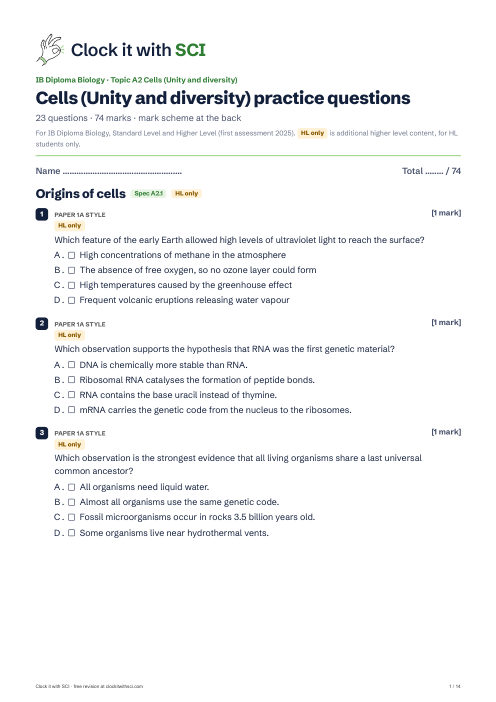 Worksheet
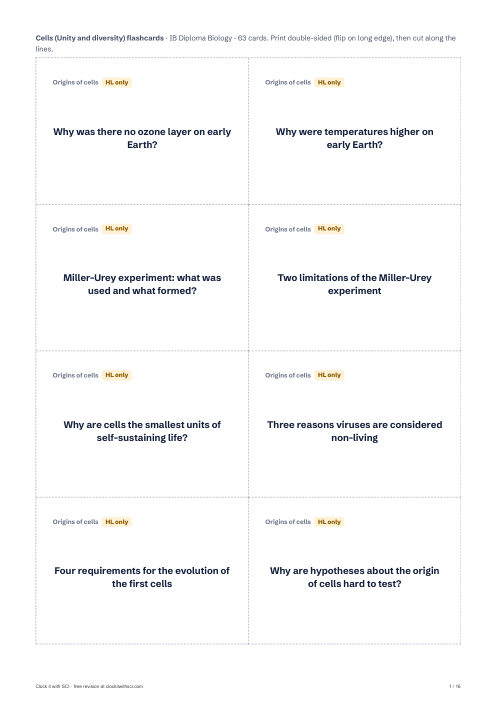 Flashcards
Subtopics
Work through them in order. Each one has notes, exam questions and flashcards, and a PDF of each.
- 1Origins of cells HL onlySpec A2.1How the first cells may have arisen: early Earth, Miller–Urey, fatty acid vesicles, the RNA world and evidence for LUCA near hydrothermal vents.NotesQuestions 8Flashcards 17
- 2Cell structure Spec A2.2Cell theory, microscopy skills and techniques, prokaryote and eukaryote cells, atypical cells, micrographs and (HL) endosymbiosis and multicellularity.NotesQuestions 8Flashcards 33
- Cell theory and structures common to all cells
- Microscopy skills
- Developments in microscopy
- Prokaryote and eukaryote cell structure
- Processes of life in unicellular organisms
- Animal, fungal and plant cells, and atypical cells
- Micrographs, drawing and annotation
- Origin of eukaryotic cells by endosymbiosis HL only
- Cell differentiation and the evolution of multicellularity HL only
- 3Viruses HL onlySpec A2.3Features shared by all viruses, their diversity, the lytic and lysogenic cycles of lambda phage, viral origins and rapid evolution of influenza and HIV.NotesQuestions 7Flashcards 13
Whole topic
When you have done the subtopics: test yourself on everything, or print the lot.