
Origins and rapid evolution of virusesSpec A2.3.5, A2.3.6
In short
The diversity of viruses suggests several origins, and their shared features may be convergent evolution resulting from obligate parasitism. Some viruses, including influenza and HIV, evolve very rapidly because they have high mutation rates, short generation times and huge numbers of offspring. As a result vaccines must be updated and antiviral drugs can quickly lose effectiveness.
Evidence for several origins
The great diversity of viruses suggests several possible origins from other organisms, rather than one common ancestor of all viruses.
- Viruses share an extreme form of obligate parasitism: none can reproduce outside a host cell. The features they have in common, such as a small size and a protein capsid, could be convergent evolution: similar features evolving separately in different lineages because of the same way of life.
- The genetic code is shared between viruses and living organisms, which suggests that viruses arose from cellular life rather than independently of it.
| Hypothesis | Idea |
|---|---|
| Escape | Pieces of genetic material, such as plasmids, escaped from cells and gained a protein coat |
| Reduction | Parasitic cells lost genes until little more than those for replication and capsids remained; very large viruses with many genes fit this idea |
Different groups of viruses may have arisen in different ways, which would fit their diversity.
Linking question: what mechanisms contribute to convergent evolution? The same selection pressures, here entering host cells and protecting a genome between hosts, can produce similar features in unrelated lineages.
Rapid evolution in viruses
- High mutation rate: RNA viruses copy their genome with RNA polymerases, and HIV uses reverse transcriptase. These enzymes do not proofread, so copying errors are frequent.
- Short generation time: a new generation of virus particles can be produced within hours.
- Huge numbers: each infected cell releases many virus particles, so there is a lot of variation for natural selection to act on.
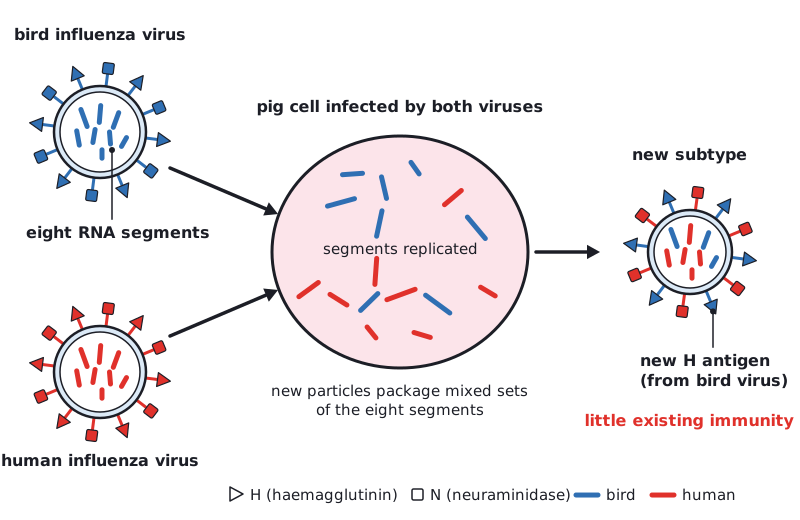
- Mixing of genes: when two strains infect the same cell, their genetic material can combine.
Influenza
Influenza A viruses have an RNA genome in eight segments and two surface glycoproteins, haemagglutinin (H) and neuraminidase (N), which antibodies recognise. Frequent mutations gradually change these antigens (antigenic drift), so antibodies from earlier infections or vaccines bind less well. If two strains infect the same host, for example a pig, their segments can mix (antigenic shift), producing a new subtype to which few people are immune. The vaccine is therefore reformulated every year to match the strains expected to circulate.
HIV
HIV's reverse transcriptase makes many errors and huge numbers of new virus particles are produced every day, so many variants exist within each infected person. When one antiviral drug is used, variants carrying resistance mutations are selected and multiply. Patients therefore take combination antiretroviral therapy: several drugs acting on different targets, so a variant would need several resistance mutations at once. The variability of HIV's surface glycoproteins has also made a vaccine very difficult to develop.
Consequences for treatment: vaccines need regular updating, antiviral drugs lose effectiveness as resistance evolves, and immunity from earlier infections gives less protection.
 (opens full size in a new tab)
Quick check
What is the protein coat of a virus called?
Show answer
The capsid.
What is a prophage?
Show answer
Viral DNA integrated into the host bacterium's chromosome.
Which host does bacteriophage lambda infect?
Show answer
The bacterium E. coli.
Give two reasons why HIV evolves rapidly.
Show answer
Reverse transcriptase does not proofread, so the mutation rate is high; and huge numbers of virus particles are produced with a short generation time.
Written and checked against the IB Biology HL specification · Updated October 2026