
Mutations, tumours and the mitotic indexSpec D2.1.16, D2.1.17
In short
A tumour is a mass of cells formed by uncontrolled cell division, caused by mutations in genes that control the cell cycle. Proto-oncogenes can mutate into oncogenes and tumour suppressor genes can lose their function. Benign tumours grow slowly and stay in place; malignant tumours invade tissue and metastasise, causing cancer.
Mutations in the genes that control the cell cycle can lead to uncontrolled cell division. Two groups of genes are involved.
| Proto-oncogenes | Tumour suppressor genes | |
|---|---|---|
| Normal role | Code for proteins that stimulate the cell cycle when division is needed | Code for proteins that slow or stop the cell cycle, for example if DNA is damaged (p53 is a well-known example) |
| Effect of mutation | Converted into an oncogene, which is permanently active and stimulates division all the time | The protein stops working, so division is no longer held back |
| Result | Uncontrolled cell division | Uncontrolled cell division |
Usually several mutations in the same cell are needed before a tumour forms. A tumour is an abnormal mass of cells that results from uncontrolled cell division.
Benign and malignant tumours
| Benign tumour | Malignant tumour | |
|---|---|---|
| Rate of cell division and growth | Usually slow | Usually fast |
| Invasion of neighbouring tissue | No: often enclosed and stays in one place | Yes: grows into neighbouring tissues |
| Metastasis | No | Yes: cells break away and spread in blood or lymph |
| Cancer? | Does not cause cancer (but can still harm by pressing on organs) | Causes cancer |
The tumour that forms first is the primary tumour. When malignant cells detach, travel in the blood or lymph and start dividing elsewhere in the body (metastasis), they form a secondary tumour.
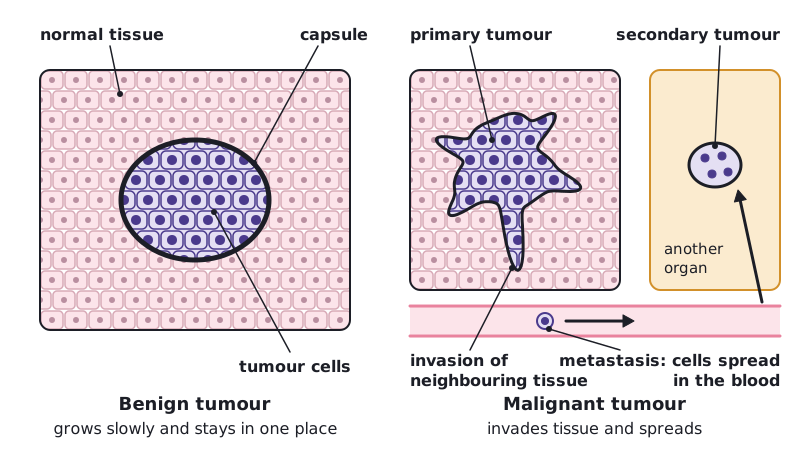 (opens full size in a new tab)
The mitotic index
Calculating a mitotic index
In a field of view of a tissue sample, 42 of 350 cells are in a phase of mitosis. Calculate the mitotic index.
- Count every cell in prophase, metaphase, anaphase or telophase: 42.
- Divide by the total number of cells: 42 ÷ 350 = 0.12.
Answer: Mitotic index = 0.12 (12% of the cells are in mitosis).
A higher mitotic index means faster cell proliferation, so it is used to compare tumours with normal tissue. Count across several fields of view and decide in advance how to treat cells you cannot classify.
To determine the mitotic index, observe a population of cells, such as a root tip squash or a prepared slide, and count cells in mitosis and in interphase. Interphase cells count in the total but not in the numerator.
Quick check
What is cytokinesis?
Show answer
The splitting of the cytoplasm of a parent cell between the daughter cells.
Give two examples of unequal cytokinesis.
Show answer
Oogenesis in humans and budding in yeast.
In which phase of mitosis do sister chromatids separate?
Show answer
Anaphase.
What happens to chromosome 21 to cause Down syndrome?
Show answer
Non-disjunction in meiosis gives a gamete with two copies, so the zygote has three copies (trisomy 21).
HL only What is the mitotic index?
Show answer
The number of cells in mitosis divided by the total number of cells observed.
Written and checked against the IB Biology HL specification · Updated October 2026