
Hershey–Chase experiment and Chargaff's dataSpec A1.2.14, A1.2.15
In short
The Hershey–Chase experiment showed DNA is the genetic material: viruses labelled with radioactive phosphorus in their DNA passed it into bacteria, while radioactive sulfur in their protein stayed outside. Chargaff's data showed that adenine equals thymine and guanine equals cytosine, but base proportions vary between species, falsifying the tetranucleotide hypothesis of a repeating four-base sequence.
The Hershey–Chase experiment
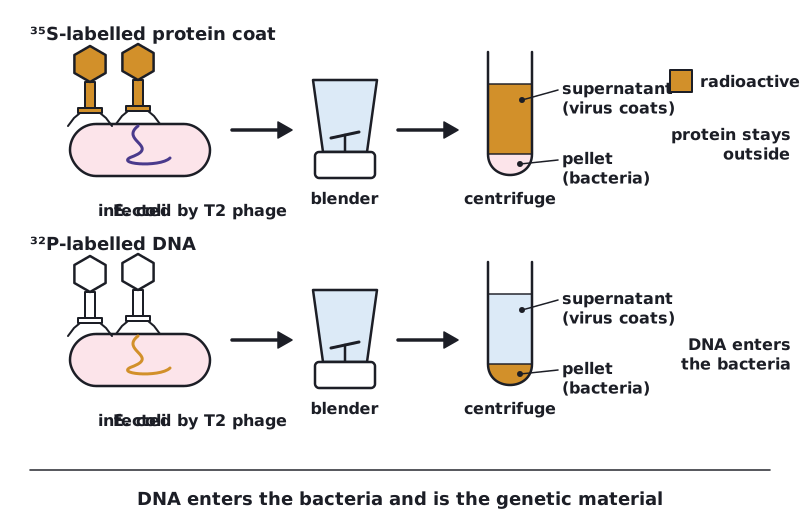
By the early 1950s it was still debated whether genes were made of protein or DNA. Hershey and Chase used T2 bacteriophage, a virus made only of a protein coat and DNA, which infects the bacterium Escherichia coli. Proteins contain sulfur but almost no phosphorus; DNA contains phosphorus but no sulfur.
- One batch of viruses was grown with radioactive sulfur (³⁵S), which labelled their protein coats. Another batch was grown with radioactive phosphorus (³²P), which labelled their DNA.
- Each batch was allowed to infect bacteria.
- The mixture was agitated in a blender to detach the virus coats from the outside of the bacteria.
- It was centrifuged: the heavier bacteria formed a pellet and the lighter virus coats stayed in the supernatant liquid.
- The radioactivity of the pellet and the supernatant was measured.
| Label | Where most radioactivity was found | What it shows |
|---|---|---|
| ³⁵S (protein) | Supernatant | Protein stayed outside the bacteria |
| ³²P (DNA) | Pellet (inside bacteria) | DNA entered the bacteria |
Because the infected bacteria went on to produce new viruses, the material that entered them must carry the instructions. Only DNA entered, so DNA is the genetic material.
Nature of science: technological developments open up new experiments. The Hershey–Chase experiment only became possible once radioisotopes were available to scientists as research tools.
Chargaff's data
Chargaff measured the relative amounts of the four bases in DNA from diverse life forms. He found that in every species the amount of adenine was about equal to thymine and guanine about equal to cytosine, so purines equalled pyrimidines. But the proportion of A + T compared with G + C varied between species.
The earlier tetranucleotide hypothesis proposed that DNA was a repeating sequence of the four bases, which would mean all four bases are present in equal amounts in every species. Chargaff's data did not fit, so they falsified it, and the idea that DNA was too simple to carry genetic information was abandoned. The A = T and G = C pattern later supported complementary base pairing in the double helix.
Nature of science: the problem of induction is that no number of agreeing observations can prove a general theory true. Falsification is more certain: one reliable set of contrary data, such as Chargaff's, is enough to show a hypothesis is false.
 (opens full size in a new tab)
Quick check
What are the three components of a nucleotide?
Show answer
A phosphate group, a pentose sugar and a nitrogenous base.
State three differences between DNA and RNA.
Show answer
DNA has two strands, RNA one; DNA has thymine, RNA uracil; DNA has deoxyribose, RNA ribose.
What does antiparallel mean in DNA?
Show answer
The two strands run in opposite directions.
HL only Why does an A–T pair have the same width as a C–G pair?
Show answer
Each pair is one purine (two rings) bonded to one pyrimidine (one ring).
HL only Which isotope labelled DNA in the Hershey–Chase experiment?
Show answer
Radioactive phosphorus, ³²P.
Written and checked against the IB Biology HL specification · Updated October 2026