
Water movement in cells with and without wallsSpec D2.3.5, D2.3.6, D2.3.7
In short
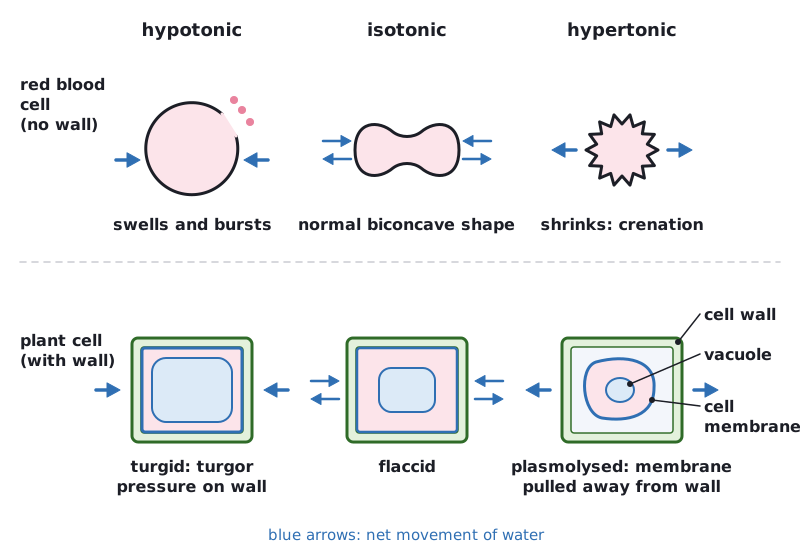
Cells without a cell wall swell and burst in a hypotonic medium and shrink and crenate in a hypertonic medium. Cells with a wall develop turgor pressure in hypotonic solutions and undergo plasmolysis in hypertonic ones. Isotonic solutions are used for intravenous fluids and for bathing organs before transplantation to prevent harmful water movement.
Cells that lack a cell wall
- Hypotonic medium: water enters, the cell swells and, with no wall to resist, may burst (red blood cells burst, called haemolysis).
- Hypertonic medium: water leaves, the cell shrinks and the membrane becomes wrinkled and spiky (crenation).
Freshwater unicellular organisms, such as Paramecium, live in a hypotonic environment and water constantly enters. They use contractile vacuoles to collect excess water and expel it from the cell, which needs energy from ATP. Without this the cell would burst.
In multicellular organisms, the tissue fluid that bathes cells must be kept isotonic with the cytoplasm to prevent harmful swelling or shrinkage. In humans, the kidneys regulate the solute concentration of blood plasma and so of tissue fluid.
Cells with a cell wall
- Hypotonic medium: water enters and the cytoplasm and vacuole push against the cell wall, developing turgor pressure. The wall resists further expansion, so the cell becomes turgid but does not burst. Turgor supports non-woody plant tissue.
- Hypertonic medium: water leaves, the cytoplasm and vacuole shrink and the cell membrane pulls away from the cell wall. This is plasmolysis. The cell becomes flaccid and the tissue wilts.
 (opens full size in a new tab)
Medical applications of isotonic solutions
- Intravenous fluids: fluids given into a vein as part of medical treatment, such as normal saline (0.9% sodium chloride), are isotonic with blood plasma so blood cells neither burst nor crenate.
- Organs for transplantation: donor organs are bathed in a cold isotonic solution, so their cells neither gain nor lose water while being stored and transported.
Linking question: how do plant and animal cells differ in their regulation of water movement? Plant cells rely on the cell wall and turgor; animal cells rely on keeping tissue fluid isotonic.
Written and checked against the IB Biology HL specification · Updated October 2026