
Gene loci, autosomal linkage and recombinantsSpec D3.2.18, D3.2.19, D3.2.20
In short
A gene's locus is its position on a particular chromosome, which databases record with its polypeptide product. Autosomal gene linkage occurs when genes are close together on the same autosome, so their alleles tend to be inherited together and fail to assort independently. Recombinants are new combinations of alleles produced by crossing over between linked genes.
Loci of human genes
The locus of a gene is its position on a particular chromosome. Online gene databases list each gene's locus and the polypeptide it codes for.
| Gene | Locus | Polypeptide product |
|---|---|---|
| HBB | Chromosome 11 (11p15.4) | Beta-globin, part of haemoglobin |
| INS | Chromosome 11 (11p15.5) | Insulin |
| PAH | Chromosome 12 (12q23.2) | Phenylalanine hydroxylase |
| F8 | X chromosome (Xq28) | Clotting factor VIII |
| ABO | Chromosome 9 (9q34.2) | Glycosyltransferase that adds the A or B sugar |
Search a gene database to find pairs of genes on different chromosomes (HBB and PAH) and pairs in close proximity on the same chromosome (HBB and INS, both near the tip of the short arm of chromosome 11, about 3 million base pairs apart).
Autosomal gene linkage
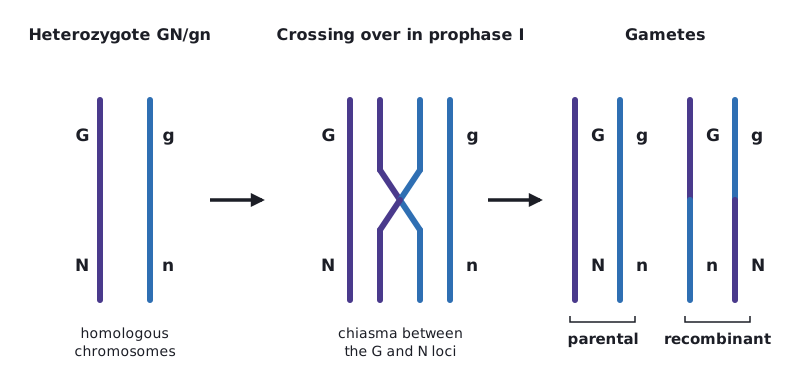
Linked genes are on the same autosome. Their alleles are carried on one chromosome together, so they tend to move into the same gamete and fail to assort independently. Only crossing over (in prophase I) between the two loci separates them, and the closer the loci, the less often this happens.
In linkage crosses, alleles are shown beside vertical lines representing homologous chromosomes. For example, a fly with A and B on one chromosome and a and b on the other is written AB/ab, drawn as A and B on the left line and a and b on the right line.
Recombinants
A recombinant has a combination of alleles not found in either parent's chromosomes. To identify them, cross an individual heterozygous for both genes with one homozygous recessive for both (a test cross): the offspring's phenotypes then reveal the gametes of the heterozygous parent.
A linked test cross
A fruit fly heterozygous for grey body (G) and normal wings (N), with genotype GN/gn, is crossed with a black-bodied, vestigial-winged fly (gn/gn). Offspring (data for practice): 412 grey normal, 398 black vestigial, 88 grey vestigial, 102 black normal. Identify the recombinants and calculate the recombination frequency.
- Parental combinations (from chromosomes GN and gn): grey normal and black vestigial, the large classes.
- Recombinant combinations (Gn and gN gametes, from crossing over): grey vestigial and black normal, the small classes.
- Recombinants = 88 + 102 = 190 out of 1000 offspring.
- Recombination frequency = 190 ÷ 1000 × 100 = 19%.
Answer: Grey vestigial and black normal are recombinants; 19%. Unlinked genes would give about 50% recombinants (1:1:1:1).
 (opens full size in a new tab)
Recombinants are identified in gametes, in the genotypes of offspring and in their phenotypes. In a test cross they are always the smaller classes when genes are linked.
Written and checked against the IB Biology HL specification · Updated October 2026