
Osmosis, channel proteins and pump proteinsSpec B2.1.5–B2.1.8
In short
Osmosis is the net movement of water across a partially permeable membrane from a lower to a higher solute concentration; aquaporins are channels that greatly speed it up. Channel proteins let specific ions diffuse through when open, and pump proteins use ATP to move specific particles against a concentration gradient. Both make membranes selectively permeable.
Osmosis
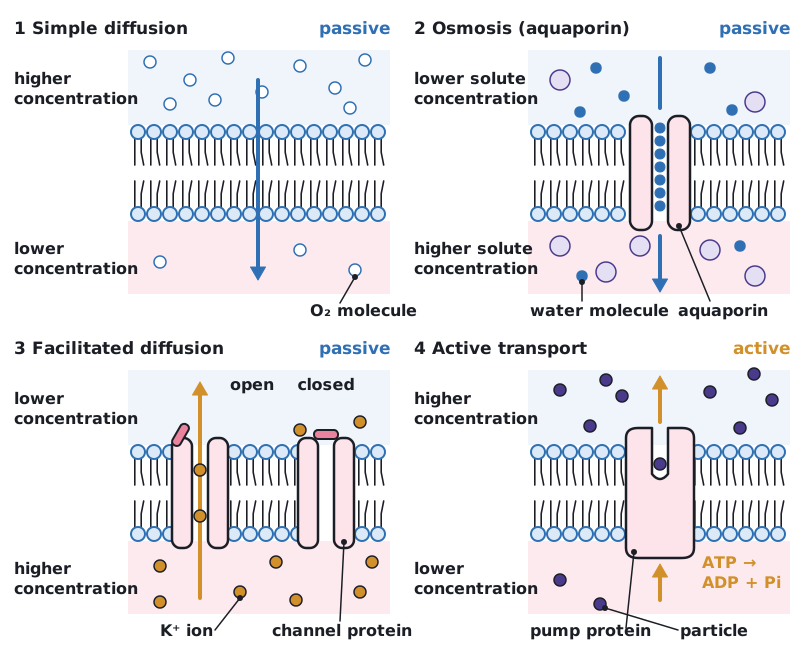
Osmosis is the net movement of water molecules across a partially permeable membrane from a region of lower solute concentration to a region of higher solute concentration.
- Water molecules move randomly and cross the membrane in both directions.
- The membrane is impermeable to the solute, so solute particles stay on their own side.
- On the side with the higher solute concentration, solute particles take up part of the solution, so the concentration of water molecules free to move across the membrane is lower there.
- More water molecules therefore cross from the side with the lower solute concentration than move back, giving a net movement of water towards the higher solute concentration.
- Osmosis is passive and continues while the difference in solute concentration remains.
Water is polar, so it crosses the lipid bilayer only slowly. Aquaporins are integral channel proteins that let water molecules pass through in single file, increasing the permeability of the membrane to water many times over. The pore is too narrow for most solutes, and charges inside it repel ions, so only water passes. Cells that move large volumes of water, such as kidney collecting duct cells and root cells, have many aquaporins.
Channel proteins and facilitated diffusion
Facilitated diffusion is passive diffusion of particles through a membrane protein. A channel protein is an integral protein with a hydrophilic pore through the membrane. The diameter of the pore and the charges lining it allow only specific ions (for example K⁺) to pass. Many channels are gated: ions diffuse through when the channel is open but not when it is closed, so the cell can control permeability.
Pump proteins and active transport
Active transport is the movement of particles across a membrane against a concentration gradient, using energy from ATP. Pump proteins bind a specific particle on one side, use energy from ATP to change shape, and release the particle on the other side. Pumps move particles in one direction only, so they can build up concentration gradients.
| Feature | Simple diffusion | Facilitated diffusion | Active transport |
|---|---|---|---|
| Direction | Down the concentration gradient | Down the concentration gradient | Against the concentration gradient |
| Energy from ATP | No | No | Yes |
| Membrane protein | None (between phospholipids) | Channel protein | Pump protein |
| Selective? | No: depends only on size and polarity | Yes: specific ions | Yes: specific particles |
| Example | O₂ and CO₂ | K⁺ through a potassium channel | Mineral ions into root hair cells |
Selectivity in membrane permeability
Facilitated diffusion and active transport give membranes selective permeability: the channel and pump proteins present decide which ions and molecules can cross. Permeability by simple diffusion is not selective. It depends only on the size of a particle and whether it is hydrophilic or hydrophobic.
 (opens full size in a new tab)
Linking question: what processes depend on active transport? Think of mineral ion uptake by roots, nerve impulses and the absorption of glucose in the gut.
Written and checked against the IB Biology HL specification · Updated October 2026