
Gated ion channels, sodium–potassium pumps and cotransportersSpec B2.1.14–B2.1.16
In short
Gated ion channels open only in response to a stimulus: nicotinic acetylcholine receptors open when acetylcholine binds, and sodium and potassium channels open when the membrane voltage changes. The sodium–potassium pump uses ATP to exchange three Na⁺ out for two K⁺ in, generating membrane potentials. Sodium-dependent glucose cotransporters use the resulting Na⁺ gradient to absorb glucose.
Gated ion channels in neurons
A gated ion channel opens or closes in response to a stimulus. Neurons use two kinds: neurotransmitter-gated and voltage-gated channels.
| Channel | Type of gate | What opens it | Effect |
|---|---|---|---|
| Nicotinic acetylcholine receptor | Neurotransmitter-gated | Acetylcholine binding to the receptor in the post-synaptic membrane | Positive ions, mainly Na⁺, diffuse in, depolarising the membrane |
| Voltage-gated sodium channel | Voltage-gated | Depolarisation of the membrane to the threshold potential | Na⁺ diffuses in rapidly, depolarising the membrane further; the channel soon closes again |
| Voltage-gated potassium channel | Voltage-gated | Depolarisation (it opens more slowly than sodium channels) | K⁺ diffuses out, repolarising the membrane |
In each case the ions move by facilitated diffusion, down their concentration gradients. The gate only controls when the channel is open.
The sodium–potassium pump: an exchange transporter
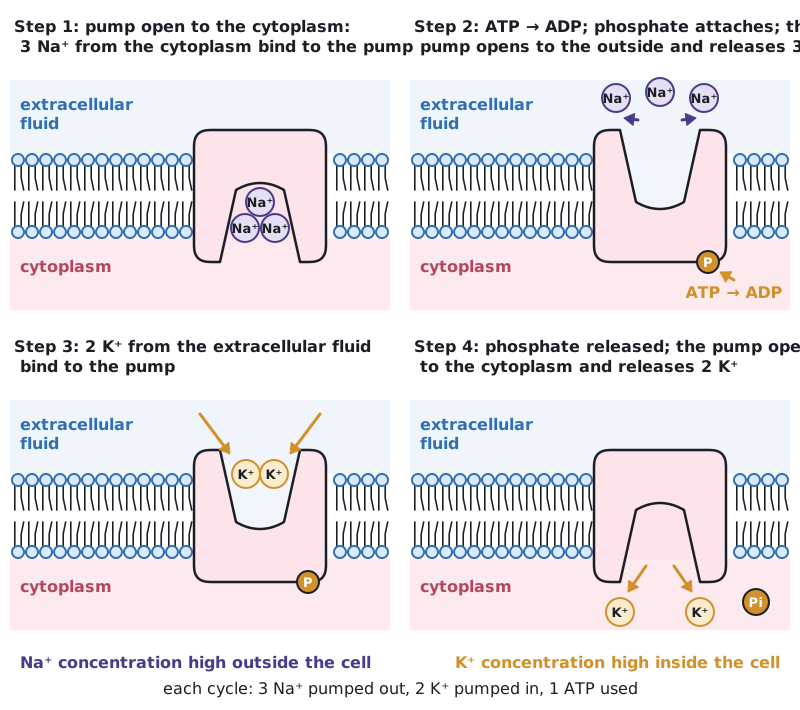
The sodium–potassium pump is an exchange transporter: in each cycle it moves two different ions in opposite directions, using energy from ATP.
- Three Na⁺ ions from the cytoplasm bind to the pump.
- ATP transfers a phosphate group to the pump. This changes its shape so it opens to the outside and releases the three Na⁺.
- Two K⁺ ions from outside the cell bind to the pump.
- The phosphate is released and the pump returns to its original shape, opening to the inside.
- The two K⁺ ions are released into the cytoplasm and the cycle repeats.
Each cycle removes one net positive charge from the cell and builds concentration gradients of Na⁺ (high outside) and K⁺ (high inside). This is how the pump helps to generate membrane potentials, including the resting potential of about −70 mV in neurons. The Na⁺ gradient is also a store of energy that other transporters can use.
 (opens full size in a new tab)
Sodium-dependent glucose cotransporters
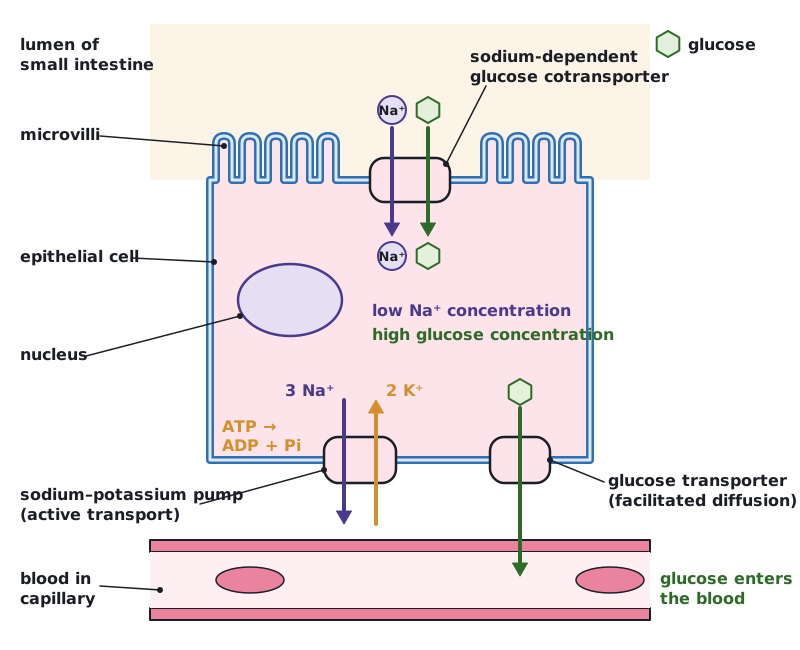
Indirect active transport uses a concentration gradient made by one pump to move another particle against its own gradient. In a sodium-dependent glucose cotransporter, Na⁺ diffuses into the cell down its concentration gradient and the protein uses this to carry glucose in at the same time, against the glucose concentration gradient. ATP is used only by the sodium–potassium pumps that keep the Na⁺ concentration inside the cell low.
- Small intestine: cotransporters in the membrane of epithelial cells facing the lumen absorb glucose from digested food. The glucose then leaves the other side of the cell by facilitated diffusion and enters the blood.
- Nephron: cotransporters in proximal convoluted tubule cells reabsorb glucose from the filtrate, so normally no glucose is lost in urine.
 (opens full size in a new tab)
Call it indirect active transport: the cotransporter itself does not use ATP, but it depends on the ATP-driven sodium–potassium pump keeping Na⁺ low inside the cell.
Written and checked against the IB Biology HL specification · Updated October 2026