
Water potentialSpec D2.3.8, D2.3.9, D2.3.10, D2.3.11
In short
Water potential is the potential energy of water per unit volume, measured in kilopascals relative to pure water at atmospheric pressure and 20°C, which is zero. Water moves from higher to lower water potential. In cells with walls, water potential is the sum of solute potential and pressure potential: ψw = ψs + ψp.
Water potential (ψw) is the potential energy of water per unit volume. The absolute amount of potential energy cannot be measured, so values are given relative to pure water at atmospheric pressure and 20°C, which is defined as zero. The units are usually kilopascals (kPa).
Movement from higher to lower water potential
Water always moves from a higher water potential to a lower water potential. This is the same as any movement that lowers potential energy, like a ball rolling downhill. Dissolving solutes lowers the potential energy of water, because water molecules are held in shells around the solute particles. Pressure raises it.
Solute potential and pressure potential
- Solute potential (ψs)
- The effect of dissolved solutes on water potential. It ranges from zero (pure water) downwards: the more concentrated the solution, the more negative ψs.
- Pressure potential (ψp)
- The effect of pressure on water potential. It is generally positive inside cells, because the wall pushes back on the protoplast; it is negative in xylem vessels where sap is transported under tension.
Predicting the direction of water movement
A plant cell has a solute potential of −800 kPa and a pressure potential of +300 kPa. It is placed in a solution with a water potential of −650 kPa. Calculate the water potential of the cell and state the direction of net water movement.
- ψw = ψs + ψp = −800 + 300 = −500 kPa.
- The solution (−650 kPa) has a lower water potential than the cell (−500 kPa).
- Water moves from higher to lower water potential: out of the cell into the solution.
Answer: ψw of the cell = −500 kPa; net movement of water is out of the cell.
Water potential and plant tissue
| Hypotonic solution | Hypertonic solution | |
|---|---|---|
| Starting point | ψw of solution is higher than ψw of cells | ψw of solution is lower than ψw of cells |
| Water movement | Into the cells | Out of the cells |
| Change in ψs | Rises slightly (less negative) as the cell sap is diluted | Falls (more negative) as the cell sap becomes more concentrated |
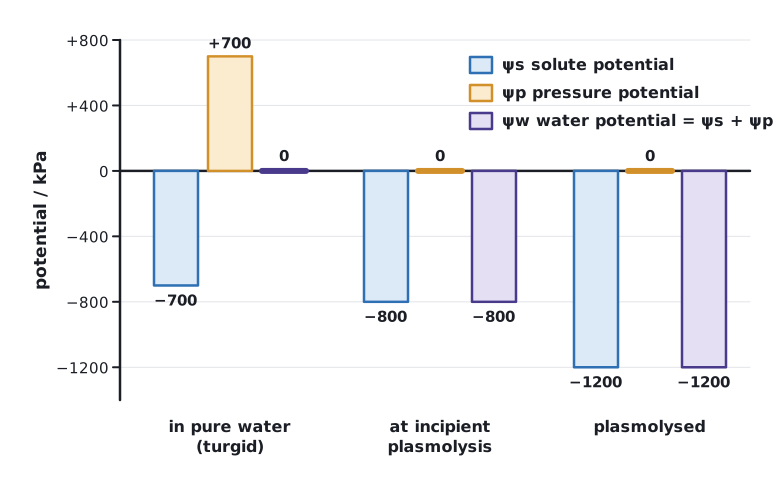
| Change in ψp | Rises as the protoplast presses on the wall | Falls to zero as the cell becomes flaccid; it stays near zero during plasmolysis |
| End point | Net uptake stops when ψw of the cells equals ψw of the solution (the cells are turgid) | Net loss stops when ψw of the cells equals ψw of the solution (the cells are plasmolysed) |
 (opens full size in a new tab)
In pure water a turgid cell reaches ψw = 0 because ψp becomes equal and opposite to ψs. Always state values with their signs and units, and compare water potentials, not solute concentrations, when using this model.
Quick check
Why are cations and anions both able to dissolve in water?
Show answer
Water is polar: cations attract the δ− oxygen ends and anions attract the δ+ hydrogen ends of water molecules.
In which direction does water move between a hypotonic and a hypertonic solution?
Show answer
From the hypotonic (less concentrated) solution to the hypertonic (more concentrated) solution.
What is plasmolysis?
Show answer
The cell membrane pulling away from the cell wall as water leaves a plant cell in a hypertonic solution.
Why are intravenous fluids isotonic?
Show answer
So that blood cells neither gain nor lose water, which would make them burst or crenate.
HL only What is the water potential of pure water at atmospheric pressure and 20°C?
Show answer
Zero (0 kPa).
Written and checked against the IB Biology HL specification · Updated October 2026