
The last universal common ancestorSpec A2.1.7, A2.1.8, A2.1.9
In short
The last universal common ancestor (LUCA) is the most recent organism from which all living things are descended. Evidence includes the universal genetic code and genes shared by all organisms. Dates are estimated from fossils, radiometric dating, carbon isotope ratios and molecular clocks, and fossil and genomic evidence suggests LUCA evolved near hydrothermal vents.
The last universal common ancestor (LUCA) is the most recent population of organisms from which all organisms now living on Earth are descended. It was not the first cell: it already had DNA, ribosomes and a membrane.
Evidence for LUCA
- The universal genetic code: almost all organisms use the same codons for the same amino acids. Such an arbitrary code is very unlikely to have evolved identically more than once.
- Shared genes across all organisms: genomic studies have identified several hundred genes found in both bacteria and archaea, including genes for ribosomal proteins and for DNA replication, transcription and translation.
- Shared biochemistry: all cells use DNA, ribosomes, ATP and the same 20 amino acids.
Other forms of life probably also evolved, but became extinct, most likely due to competition from LUCA and its descendants. This explains why all life today shares one genetic code.
Estimating the dates of the first cells and LUCA
| Approach | How it works |
|---|---|
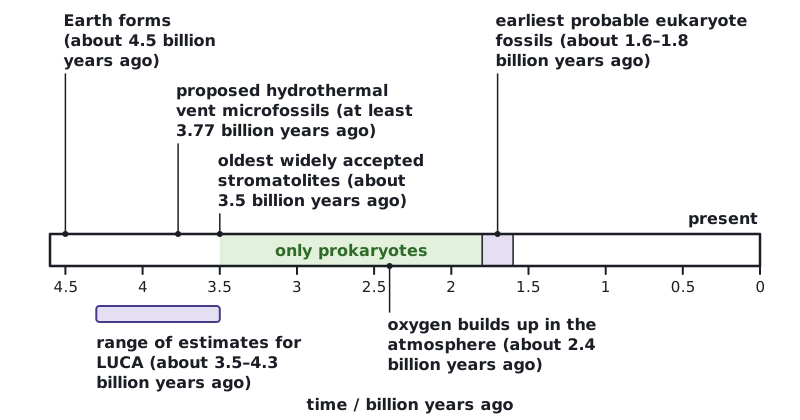
| Fossils | Microfossils and stromatolites (layered rocks built by mats of microbes) show that cells were present; the oldest widely accepted stromatolites, from Western Australia, are about 3.4–3.5 billion years old |
| Radiometric dating | Radioactive isotopes in rocks decay at a known rate (fixed half-life), so the age of the rock containing a fossil is calculated from the ratio of parent isotope to decay product |
| Carbon isotope ratios | Organisms take up carbon-12 in preference to carbon-13, so carbon enriched in carbon-12 in ancient rocks suggests biological activity |
| Molecular clock | Differences in the base sequences of conserved genes build up at a roughly constant rate; calibrated with dated fossils, the number of differences estimates when lineages split, back towards LUCA |
Earth is about 4.5 billion years old. Evidence for the first cells ranges from widely accepted fossils about 3.5 billion years old to disputed traces that are older: possible vent microfossils at least 3.77 billion years old and carbon enriched in carbon-12 in a 4.1-billion-year-old mineral grain. Molecular clock estimates for LUCA vary widely between studies; a 2024 study put it at about 4.2 billion years ago. Life has therefore been evolving for an immense length of time, roughly 4 billion years.
 (opens full size in a new tab)
Evidence that LUCA evolved near hydrothermal vents
Hydrothermal vents on the sea floor release hot, mineral-rich water. They provide energy from chemical gradients, such as dissolved hydrogen, and iron and sulfur minerals that can act as catalysts.
- Fossil evidence: tiny tubes and filaments resembling microbes have been found in ancient sea-floor hydrothermal vent precipitates in rocks from Quebec, Canada, that are at least 3.77 billion years old.
- Genomic evidence: conserved sequences traced back to LUCA include genes for living without oxygen and at high temperatures, for using hydrogen and carbon dioxide, and for many iron–sulfur proteins. These match the conditions at hydrothermal vents.
LUCA was not the first living cell. It was a later, already complex organism; earlier lineages existed but left no surviving descendants.
Quick check
Why did ultraviolet light reach the surface of early Earth?
Show answer
There was no free oxygen and therefore no ozone layer to absorb it.
Name the four requirements for the evolution of the first cells.
Show answer
Catalysis, self-replication of molecules, self-assembly and compartmentalisation.
Which molecule in the ribosome catalyses peptide bond formation?
Show answer
rRNA, acting as a ribozyme.
Give two pieces of evidence for a last universal common ancestor.
Show answer
The universal genetic code and genes shared by all organisms.
Written and checked against the IB Biology HL specification · Updated October 2026