
Lytic and lysogenic cyclesSpec A2.3.3, A2.3.4
In short
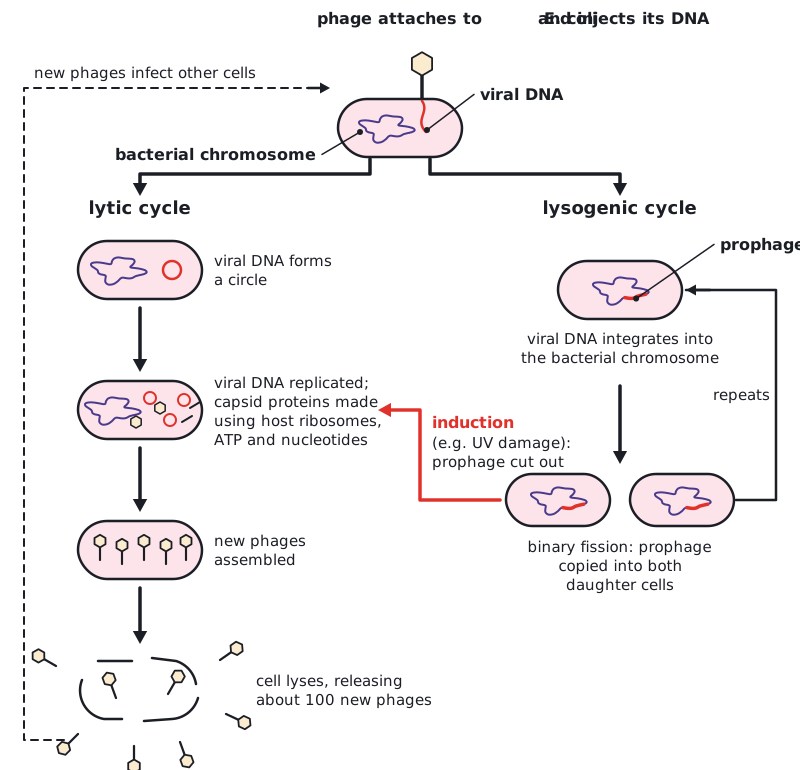
In the lytic cycle, bacteriophage lambda attaches to an E. coli cell, injects its DNA and uses the host's energy supply, nucleotides, amino acids and ribosomes to make new viruses, which are released when the cell bursts. In the lysogenic cycle, the viral DNA integrates into the host chromosome as a prophage and is copied each time the bacterium divides.
Viruses rely on a host cell for energy supply, nutrition, protein synthesis and other life functions. Bacteriophage lambda infects E. coli and can follow either of two cycles.
Lytic cycle
- Attachment: the tip of the phage tail binds to a specific receptor protein on the outer surface of E. coli.
- Injection: the phage injects its DNA into the cell; the empty capsid stays outside.
- Replication and synthesis: the linear viral DNA forms a circle. Viral genes are transcribed by the host's RNA polymerase and translated by host ribosomes, using the host's ATP, nucleotides and amino acids. The viral DNA is replicated many times.
- Assembly: capsid proteins assemble into heads and tails, and copies of the viral DNA are packed into the heads.
- Lysis and release: viral proteins make holes in the plasma membrane and a viral enzyme (endolysin) breaks down the cell wall, so the cell bursts, and around 100 new phages are released to infect other cells.
Lysogenic cycle
- Attachment and injection happen as in the lytic cycle.
- The lambda DNA integrates into the host chromosome at a specific site, catalysed by a viral enzyme, integrase. The integrated viral DNA is called a prophage.
- A viral repressor protein switches off the genes needed for the lytic cycle, so no new viruses are made and the host survives.
- Each time the bacterium divides by binary fission, the prophage is replicated with the host chromosome and passed to both daughter cells.
- If the host is stressed, for example when its DNA is damaged by ultraviolet light, the prophage is cut out of the chromosome and the lytic cycle begins. This is called induction.
| Feature | Lytic cycle | Lysogenic cycle |
|---|---|---|
| Viral DNA | Stays separate from the host chromosome | Integrated into the host chromosome as a prophage |
| New virus particles | Made quickly | Not made while the prophage is dormant |
| Effect on the host | Killed by lysis | Survives and divides normally |
| How the virus spreads | Released phages infect new cells | Copied to daughter cells when the host divides |
 (opens full size in a new tab)
In a lytic cycle answer, name the host resources used: ATP, nucleotides, amino acids, ribosomes and enzymes. These earn the marks for 'viruses rely on a host cell'.
Written and checked against the IB Biology HL specification · Updated October 2026