
Intracellular and extracellular reactions, heat and metabolic pathwaysSpec C1.1.11, C1.1.12, C1.1.13
In short
Intracellular enzymes catalyse reactions inside cells, such as glycolysis in the cytoplasm and the Krebs cycle in the mitochondrial matrix. Extracellular enzymes are secreted and act outside cells, as in chemical digestion in the gut. Metabolic reactions are never 100% efficient, so heat is always generated. Pathways are linear, like glycolysis, or cyclical, like the Krebs and Calvin cycles.
Intracellular and extracellular enzymes
| Intracellular | Extracellular | |
|---|---|---|
| Where the enzyme acts | Inside the cell that made it | Outside the cell that made it, after secretion by exocytosis |
| Examples | Glycolysis (cytoplasm); Krebs cycle (mitochondrial matrix) | Chemical digestion in the gut lumen, e.g. amylase, proteases and lipase |
| Why | Products are used within the cell | Food macromolecules are too large to enter cells, so they must be hydrolysed first |
Heat from metabolism
No metabolic reaction is 100% efficient in energy transfer. Some energy is always transferred to the surroundings as heat, so heat generation is inevitable. Mammals and birds (and some other animals, such as some large fish and insects) depend on this heat to maintain a constant body temperature. They can increase heat output by increasing the rate of metabolic reactions, for example by shivering.
Linear and cyclical pathways
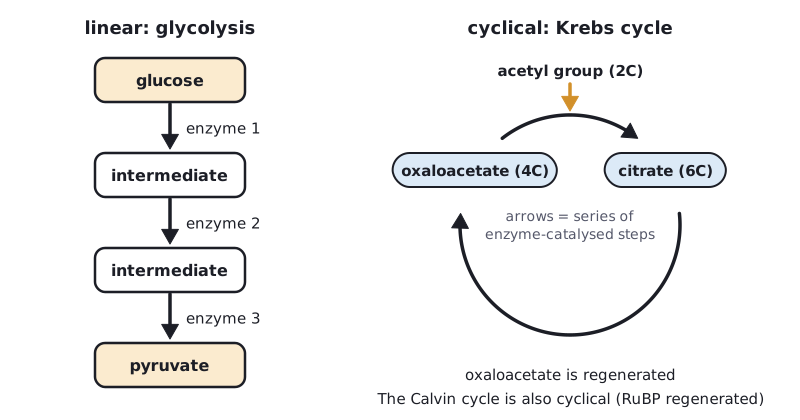
In a linear pathway, the substrate is converted through a chain of intermediates to an end product, each step catalysed by a different enzyme. Glycolysis is linear: glucose is converted step by step to pyruvate.
In a cyclical pathway, the last step regenerates the molecule that started the cycle, so intermediates are not used up. In the Krebs cycle an acetyl group joins oxaloacetate and oxaloacetate is regenerated. In the Calvin cycle CO₂ is fixed by RuBP and RuBP is regenerated.
 (opens full size in a new tab)
To classify a pathway, ask whether the starting molecule is regenerated. If it is, the pathway is cyclical; if the substrate is used up to form an end product, it is linear.
Written and checked against the IB Biology HL specification · Updated October 2026