
Origin of water on Earth and the search for lifeSpec A1.1.7, A1.1.8
In short
Earth's water is thought to have an extraplanetary origin: it was probably delivered by water-containing asteroids early in Earth's history. Earth retained it because its gravity holds the atmosphere and temperatures are low enough for water to condense into liquid. Because life depends on liquid water, the search for extraterrestrial life focuses on planets in the Goldilocks zone.
Extraplanetary origin of water
Earth's water is thought to have an extraplanetary origin. The leading hypothesis is that much of it was delivered by asteroids that collided with the early Earth. Some asteroids contain water locked in their minerals, and in meteorites from these asteroids the ratio of deuterium (heavy hydrogen) to ordinary hydrogen in the water is similar to the ratio in Earth's oceans, which supports the hypothesis.
Why Earth retained its water
- Gravity: Earth is massive enough for its gravity to hold an atmosphere, so water vapour is not lost to space.
- Temperature: Earth's surface has stayed at temperatures low enough for water to condense into liquid, forming oceans.
The abundance of liquid water over billions of years of Earth's history has allowed life to evolve.
Water and the search for extraterrestrial life
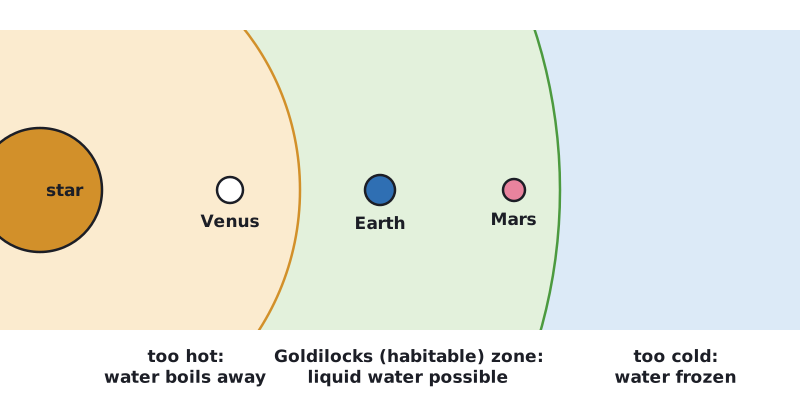
All known life needs liquid water as its medium, so the search for life on other planets and moons starts by looking for water. The Goldilocks zone (habitable zone) is the range of distances from a star in which a planet's surface is neither too hot nor too cold for liquid water to exist. Planets found in this zone around other stars are priority targets. Within our solar system, evidence of past or present water on Mars and beneath the ice of some moons also makes them targets.
 (opens full size in a new tab)
The guide limits this to asteroids as the source of water, and to gravity and low enough temperatures as the reasons it was retained. Use those exact ideas.
Quick check
Why is a water molecule polar?
Show answer
Electrons in the O–H covalent bonds are shared unequally, so oxygen is δ− and the hydrogens are δ+, and the bent shape means the charges do not cancel.
What is the difference between cohesion and adhesion?
Show answer
Cohesion is attraction between water molecules; adhesion is attraction of water to polar or charged materials.
Name two physical properties of water that differ from air and matter to aquatic animals.
Show answer
Any two of: buoyancy, viscosity, thermal conductivity, specific heat capacity.
Why do membranes depend on phospholipid tails being hydrophobic?
Show answer
The hydrophobic tails do not dissolve in water, so they form a barrier to ions and polar molecules.
HL only What is the Goldilocks zone?
Show answer
The range of distances from a star where temperatures allow liquid water on a planet's surface.
Written and checked against the IB Biology HL specification · Updated October 2026