
Feedback inhibition and mechanism-based inhibitionSpec C1.1.16, C1.1.17
In short
Feedback inhibition is regulation of a metabolic pathway by its end product, which binds to an allosteric site on an enzyme early in the pathway; isoleucine inhibits threonine deaminase this way. Mechanism-based inhibition is irreversible: penicillin binds to the active site of bacterial transpeptidases and chemically changes it. Bacteria with altered transpeptidases that penicillin cannot bind are resistant.
Feedback inhibition
In feedback inhibition the end product of a metabolic pathway inhibits an enzyme that catalyses an early step, usually the first. The end product binds to an allosteric site, so this is a form of non-competitive inhibition, and binding is reversible.
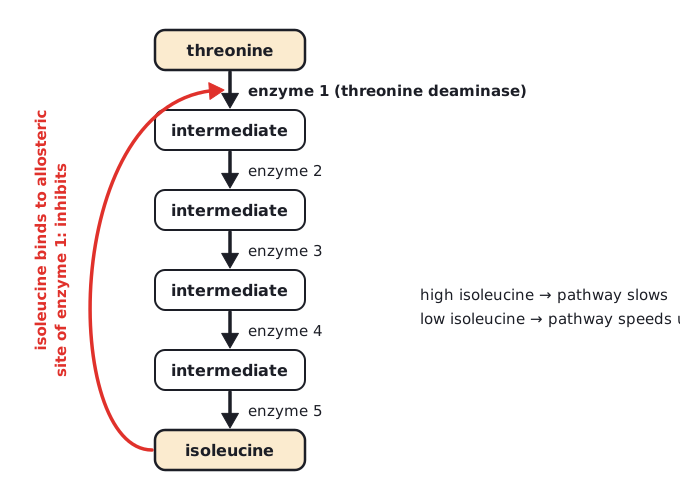
The pathway that produces the amino acid isoleucine from threonine has five steps, each catalysed by a different enzyme. Isoleucine binds to the allosteric site of the first enzyme, threonine deaminase (also called threonine dehydratase).
- When isoleucine concentration is high, more isoleucine molecules bind to threonine deaminase.
- The enzyme is inhibited, so the whole pathway slows and less isoleucine is made.
- As isoleucine is used up (for example in protein synthesis), its concentration falls and it leaves the allosteric sites.
- The enzyme becomes active again and production increases.
The concentration of the end product is therefore kept within a narrow range, and threonine and energy are not wasted making isoleucine that is not needed.
 (opens full size in a new tab)
Mechanism-based inhibition
In mechanism-based inhibition an inhibitor binds irreversibly to the active site and causes a chemical change to it, so the enzyme is permanently inactivated. Raising the substrate concentration has no effect.
Penicillin inhibits transpeptidases, bacterial enzymes that form the cross-links between peptidoglycan chains in the cell wall. Penicillin enters the active site and forms a permanent covalent bond with an amino acid there. Without cross-links, the walls of growing bacteria are weak and the cells burst due to osmotic pressure.
Some bacteria are resistant to penicillin because they have a changed transpeptidase. Its active site has a different structure, so penicillin binds poorly or not at all, but the enzyme can still make cross-links. The gene for the altered transpeptidase can spread through a population by natural selection when penicillin is used.
Mechanism-based inhibition is not competitive inhibition. Competitive inhibitors bind reversibly; penicillin binds irreversibly and changes the active site chemically.
Quick check
What is metabolism?
Show answer
The complex network of interdependent and interacting chemical reactions occurring in living organisms.
Give one example of an anabolic and one of a catabolic reaction.
Show answer
Anabolic: protein synthesis, glycogen formation or photosynthesis. Catabolic: hydrolysis in digestion or oxidation of glucose in respiration.
In the induced-fit model, what changes shape when the substrate binds?
Show answer
Both the substrate and the enzyme's active site.
What happens to the activation energy and the overall energy change when an enzyme catalyses a reaction?
Show answer
The activation energy is lowered; the overall energy change is unchanged.
HL only Which enzyme does isoleucine inhibit in feedback inhibition?
Show answer
Threonine deaminase, the first enzyme of the pathway, at its allosteric site.
Written and checked against the IB Biology HL specification · Updated October 2026